
structural steel fabrication explained
Short answer
Structural steel fabrication is the process of cutting, bending, welding, and assembling raw steel into finished load-bearing components for buildings, bridges, and ships. The fabrication stage itself generates 0.0967 kg CO₂e per kg of steel, while material waste during fabrication requires a 1.0771 material multiplier, meaning 7.71% extra steel must be sourced to account for cutting and scrap losses. U.S. fabricators earned a median annual wage of $48,480 in May 2023, with 57,810 structural metal fabricators and fitters employed nationwide.
What Is Structural Steel Fabrication: Definition, Materials, and Core Process#
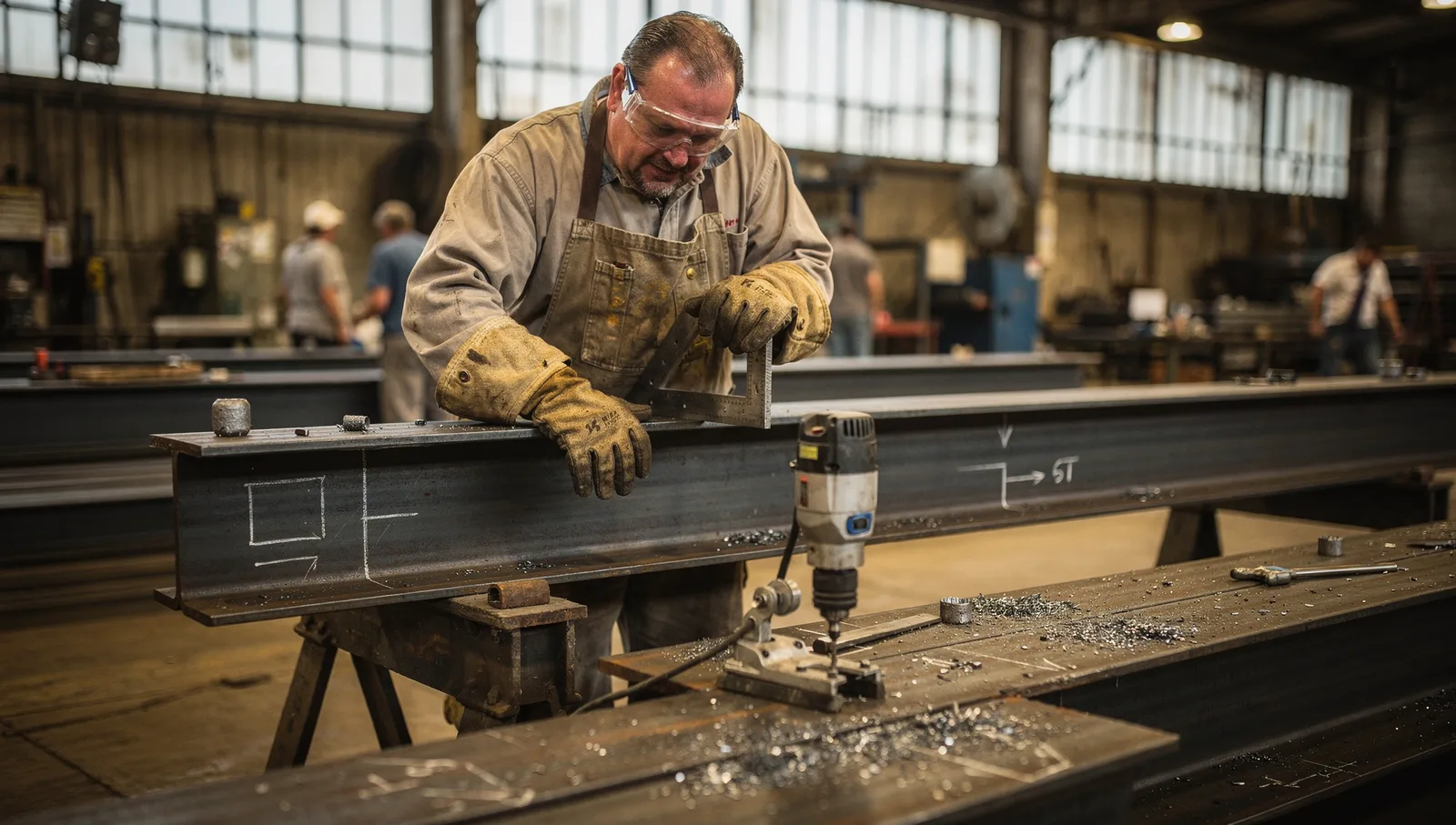
Structural steel fabrication is the controlled transformation of raw steel into load-bearing components and assemblies that form the skeleton of buildings, bridges, industrial equipment, and infrastructure. The discipline exists because raw mill steel cannot be used as-is: it must be cut to length, bent to profile, drilled for bolts, and welded into rigid frames that meet building codes and carry predictable loads. Every step from material receipt through final assembly is governed by standards, inspected for defects, and documented to prove compliance. This is where precision language matters: a fabricator does not simply "make steel structures", it converts specification into certified assemblies whose every joint, dimension, and material grade is traceable and defensible.
Material Composition and Steel Grades#
Structural steel is iron alloyed with carbon and small amounts of manganese, silicon, and other elements to achieve specific strength and workability properties. The most common grade in North America is ASTM A36, which carries a yield strength of 36 ksi (kilopounds per square inch) and a tensile strength of 58 to 80 ksi. Yield strength is the stress at which the steel begins to deform permanently; tensile strength is the maximum stress it can withstand before rupture. A36 is favored because it balances strength, weldability, and cost, making it the default for buildings, bridges, and machinery frames where moderate loads and standard fabrication techniques apply.
Higher-grade steels like A572 (50 ksi yield) and A588 (weathering steel) serve specialized roles. A572 is used where tighter weight budgets or higher loads demand greater strength per pound; A588 eliminates the need for paint in outdoor structures by forming a protective rust layer. The choice of grade directly affects fabrication method, welding parameters, and final cost. A36 welds readily with standard MIG or stick processes; higher grades require preheating and controlled cooling to avoid brittle fractures in the heat-affected zone adjacent to the weld.
The Fabrication Process: From Mill to Assembly#
The structural steel fabrication workflow follows a predictable sequence, though each project introduces site-specific variations that separate routine work from problem-solving.
- Structural Steel Fabrication Workflow
- Material Receipt & Inspection
- Cutting & Drilling
- Bending & Forming
- Welding & Assembly
- Inspection & Testing
- Shipping & On-Site Assembly
Material Receipt and Inspection. Steel arrives at the fabrication shop in coils, plates, or beams. The fabricator verifies mill certifications (which confirm grade, chemistry, and mechanical properties), checks dimensions against the purchase order, and visually inspects for surface defects, laminations, or mill scale that would compromise weld quality. This step is non-negotiable: a material defect caught here costs a few hours of delay; the same defect discovered after welding costs rework or scrap.
Cutting and Drilling. Plasma cutting, oxy-fuel cutting, or band saws reduce raw material to component length. Holes for bolts are drilled or punched to precise location and diameter. Tolerances here are typically tight enough to ensure bolts fit and pieces align during assembly, yet loose enough to avoid excessive tool wear. Overage (extra material cut away as waste) typically represents 7.71% of the finished product weight, a figure that directly affects material cost and environmental footprint.
Bending and Forming. Structural shapes are bent cold (for minor angles) or heated (for tight radii or thick material) using hydraulic presses or rolling machines. Heating introduces risk: if the steel cools too fast, the heat-affected zone becomes brittle. Controlled cooling or stress-relief heat treatment after forming prevents this. For non-standard applications, custom gates, security cages, or anti-theft enclosures, bending is often the step that separates a routine job from a problem-solving exercise, because the customer's design may not account for the material's actual bend radius or the tooling available in the shop.
Welding and Assembly. Components are tack-welded (temporary, low-strength welds to hold position) and then fully welded using MIG (metal inert gas) or stick (shielded metal arc) processes. MIG is faster and produces cleaner beads; stick is more forgiving in field conditions and on rusty or painted surfaces. Every weld must be made by a certified welder (AWS D1.1 certification is the industry standard) and inspected visually and, for critical joints, by ultrasonic testing (BUT) to detect internal defects. The welder's skill and the process parameters (voltage, wire feed speed, shielding gas) directly determine joint strength and durability.
Inspection and Testing. After welding. The assembly is inspected for dimensional accuracy, surface defects, and weld quality. Ultrasonic testing (UT) or radiography (X-ray) detects internal flaws; dye penetrant testing (PT) reveals surface cracks invisible to the eye. A third-party inspector (often required by building codes) verifies that every joint meets the contract specification and the applicable AWS or AISC standard. Documentation of every inspection becomes part of the permanent record, proof that the structure was built to code.
Shipping and On-Site Assembly. Fabricated pieces are shipped to the job site, where they are bolted or welded together into the final structure. On-site welding introduces variables the shop cannot control: weather (rain, wind, cold), surface condition (rust, paint, mill scale), and site access. This is where mobile welding expertise and rapid mobilization become critical.
Industry Standards and Specifications#
Structural steel fabrication is governed by three overlapping standards: ASTM (material specifications), AWS (welding standards), and AISC (design and fabrication practice).
Material specifications (A36, A572, A588, etc.) that define the chemical composition, mechanical properties, and testing requirements for each steel grade. A fabricator must verify that incoming material meets its ASTM specification before use.
The American Welding Society (AWS) publishes D1.1, the standard for structural steel welding. It specifies welder qualification tests, welding procedures, inspection methods, and acceptance criteria for every type of joint and loading condition. A welder certified to D1.1 has demonstrated, through a practical test, the ability to produce sound welds in the positions and materials relevant to structural work.
The American Institute of Steel Construction (AISC) publishes the Steel Construction Manual, which covers design, fabrication tolerances, and best practices. AISC's Code of Standard Practice for Steel Buildings and Bridges defines what a fabricator is responsible for and what the erector (the on-site assembly team) is responsible for, a critical boundary that prevents disputes.
Every contract for structural steel fabrication should reference these standards explicitly. A vague specification ("weld per code") is a recipe for conflict; a precise one ("AWS D1.1, ASTM A36, AISC tolerances") leaves no room for interpretation.
Why Capital M's Hands-On Expertise Beats Factory-Floor-Only Competitors#
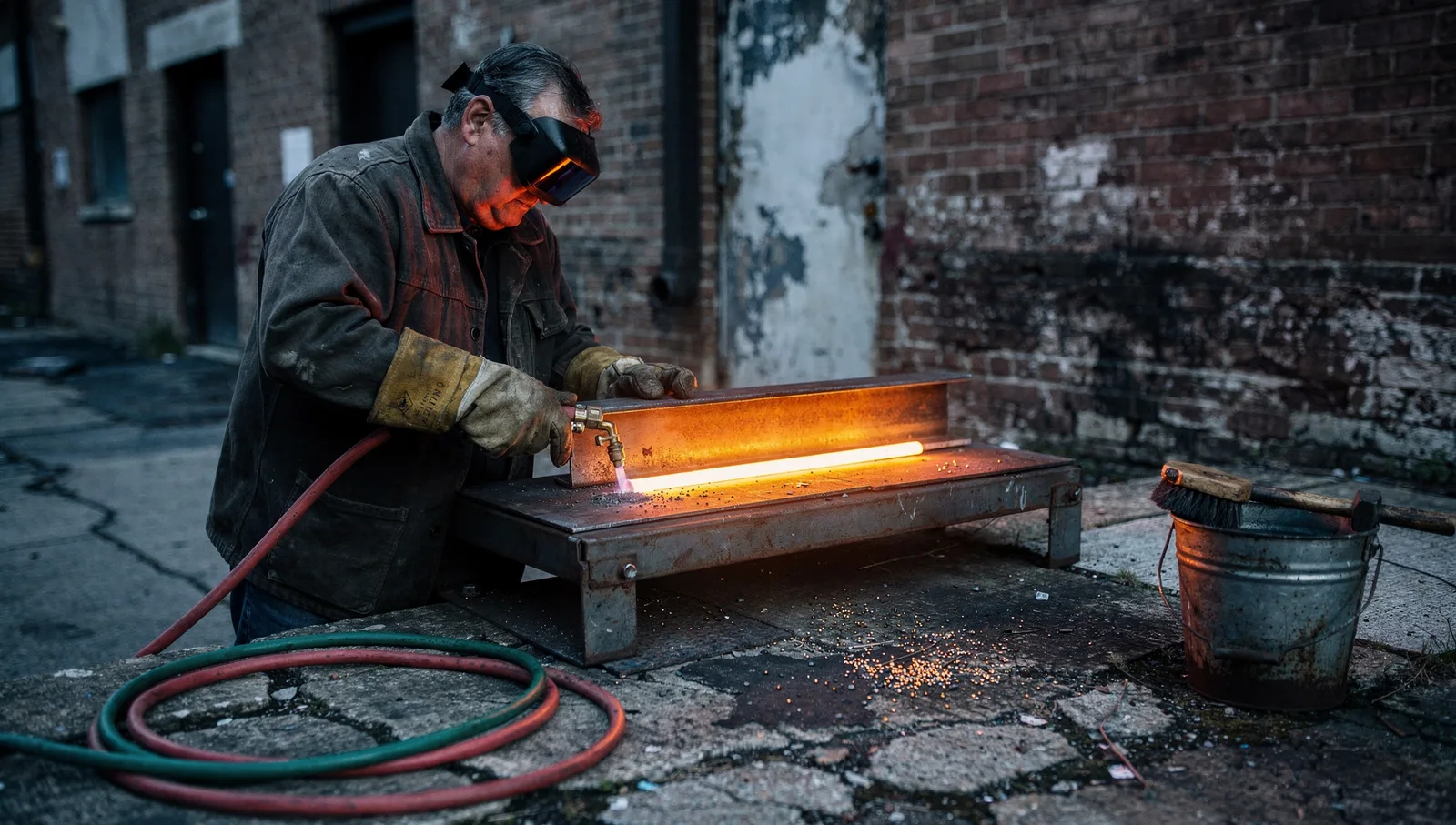
The gap between a fabrication shop and a mobile welding service is not merely one of location, it is a difference in problem-solving approach. A shop fabricator works from a drawing in a controlled environment; a mobile welder works from a drawing, a photograph, a verbal description, and the actual site condition, often under time pressure. The discipline of structural steel fabrication exists precisely to close this gap: to ensure that whether a joint is made in a climate-controlled shop or on a freezing job site at midnight, it meets the same standard and carries the same load.
24-Hour Emergency Mobilization and Rapid On-Site Welding#
A broken gate, a collapsed railing, or a structural crack in a security cage cannot wait for a shop appointment. Emergency structural repair demands immediate response: assessment on-site, material procurement, and welding execution within hours, not days. Capital M's 24-hour emergency mobilization serves the Detroit metro area (Hamtramck, Ferndale, Royal Oak, Warren, Dearborn, Southfield, Highland Park) with mobile welding trucks equipped for MIG and stick welding, cutting, and temporary bracing.
The economics of emergency response are straightforward: the cost of a mobile welder's hourly rate is far lower than the cost of a closed business, a safety hazard, or a liability claim. A restaurant with a broken exhaust hood, a warehouse with a failed door frame, or a parking structure with a cracked support beam cannot operate safely until the repair is complete. In these cases, rapid mobilization is not a luxury, it is the only acceptable option.
On-site welding introduces constraints that shop fabrication does not face. Weather is the first: rain and wind disrupt shielding gas, cold slows cooling and can embrittle the heat-affected zone, and humidity promotes corrosion. A mobile welder must be trained to work in these conditions, using techniques like wind breaks, preheat, and post-weld heat treatment to ensure the joint is as sound as one made in a shop. Surface condition is the second: a site-fabricated joint often must be made on rusty, painted, or contaminated steel, whereas shop material arrives clean. Stick welding is more forgiving of these conditions than MIG, which is why emergency repairs often default to stick process.
Custom Fabrication for Non-Standard Applications: Gates, Railings, Security Cages, and Anti-Theft Enclosures#
Standard structural shapes and assemblies are designed for predictable loads and standard details. Custom applications, a driveway gate with a specific span, a railing for an unusual height or angle, a security cage around an air-conditioner unit, or an anti-theft enclosure for equipment, demand bespoke design and fabrication. These jobs are where a fabricator's problem-solving skill separates routine work from value-added service.
A security cage for an air-conditioner unit is a common example. The customer's goal is to prevent theft while maintaining airflow and serviceability. The constraints are the unit's dimensions, the mounting surface (concrete, brick, or steel), the local climate (rust risk, wind load), and the customer's budget. A factory-floor-only fabricator works from a standard drawing and a purchase order; a mobile fabricator assesses the actual site, identifies conflicts (a roof overhang that blocks access, a wall that is not plumb, a foundation that is cracked), and adapts the design in real time. The result is a cage that fits, functions, and lasts, not a standard design that requires costly field modification or, worse, does not work at all.
Anti-theft enclosures for air-conditioner units are available from several manufacturers, but site-specific custom cages often outperform stock units because they account for local conditions. A cage designed for a flat roof in Detroit must handle snow load and freeze-thaw cycles; one for a sloped roof must account for water runoff and uneven support. Custom fabrication allows the welder to specify material thickness, weld pattern, and drainage details that a generic design cannot.
Site-Specific Problem-Solving: Mobile Fabrication Constraints and Real-World Solutions#
The difference between a drawing and reality is where expertise lives. A gate drawing specifies a 20-foot span and a 6-foot height; the actual site has a 20-foot-2-inch span (because the posts are not perfectly plumb), a clear height slightly lower than the drawing assumed (because the lintel is lower than expected), and a settlement crack in the concrete foundation. A shop fabricator builds to the drawing and ships it; a mobile fabricator measures twice, adapts once, and delivers a gate that fits and functions.
Mitch, Owner & Lead Welder at Capital M, has found that the most common on-site problems are not welding defects, they are design conflicts that a shop fabricator never sees. A railing designed for a standard post size arrives to find the actual post is slightly smaller, requiring field modification of the connection. A security cage designed for a flat roof must be adapted to a sloped pitch, changing the load path and requiring reinforcement. A gate designed for a full swing must fit a partial opening because a building addition now blocks the full swing. These are not failures of the fabricator; they are the inevitable gap between design and site reality. A mobile fabricator who can assess, adapt, and execute on-site closes that gap and earns the customer's trust.
Structural Steel vs. Aluminum: Applications, Quality Control, and Material Trade-Offs#
Structural steel and aluminum are both used in fabrication, but they serve different applications and carry different trade-offs in strength, cost, durability, and welding difficulty. Understanding when to use each is essential for a fabricator and a customer alike.
Where Structural Steel Excels vs. Aluminum Trade-Offs#
Structural steel is stronger, denser, and cheaper than aluminum. A steel beam carries more load per pound than an aluminum beam of the same size, which is why steel dominates in buildings, bridges, and heavy machinery. Steel is also more forgiving in fabrication: it welds readily with standard equipment, tolerates surface contamination better than aluminum, and does not require exotic shielding gases or strict temperature control. For a gate, a railing, or a security cage, steel is the default because the cost is low, the material is abundant, and the fabrication techniques are well-established.
Aluminum excels where weight matters. Aircraft frames, portable equipment, and marine structures use aluminum because a lighter structure means lower fuel consumption, easier handling, or better performance. Aluminum also resists corrosion without paint, which is valuable in coastal environments or food-processing facilities where salt spray or washdown would corrode steel. However, aluminum is more expensive than steel (roughly three to four times the material cost for equivalent strength), welds less forgivingly (it requires inert-gas shielding, strict cleanliness, and careful heat control), and is harder to inspect (ultrasonic testing is less reliable in aluminum than in steel).
For a customer asking "should I use aluminum or steel?", the answer depends on the application. If weight is not a constraint and corrosion is manageable with paint, steel is the economical choice. If the structure must be lightweight, corrosion-resistant, and the customer can absorb higher material and labor costs, aluminum is justified. A mobile welding service that offers both MIG (for aluminum) and stick (for steel) can serve a wider range of customers, but the skill sets are distinct: aluminum welding requires different technique, different shielding gas (argon for aluminum, CO2 or argon-CO2 mix for steel), and different filler material.
Quality Control, Inspection, and Welding Certification#
Quality control in structural steel fabrication rests on three pillars: material verification, process control, and inspection.
Material Verification. Every shipment of steel arrives with a mill certificate that documents the grade, chemistry, and mechanical properties. The fabricator verifies that the material matches the purchase order and the specification. For critical applications (seismic-resistant buildings, bridges, pressure vessels), the fabricator may conduct additional testing: tensile tests, impact tests, or ultrasonic scanning for internal defects. This step is non-negotiable because a material defect discovered after welding is far more costly to remedy than one caught at receipt.
Process Control. The welding procedure, the voltage, wire feed speed, travel speed, preheat temperature, and shielding gas, must be documented and followed consistently. A welder who deviates from the procedure (running hotter to weld faster, skipping preheat to save time) may produce a joint that looks sound but is brittle or prone to cracking under load. Process control is enforced through welder certification (AWS D1.1 tests verify that a welder can produce sound joints under controlled conditions) and procedure qualification (a test weld made under the exact conditions the job will use, then tested to destruction to prove it meets strength requirements).
Inspection. After welding. Every joint is inspected visually for cracks, incomplete fusion, or undercut. Critical joints are inspected with ultrasonic testing (UT), which sends sound waves through the weld and detects internal voids or cracks. Dye penetrant testing (PT) reveals surface defects. Radiography (X-ray) is used for the most critical joints but is expensive and time-consuming. The inspection standard (AWS D1.1, AISC Code of Standard Practice) specifies which joints require which inspection method and what acceptance criteria apply. A joint that fails inspection must be repaired (ground out and re-welded) and re-inspected, adding time and cost.
For a customer or a contractor evaluating a fabricator, the key question is: "What is your inspection protocol, and who performs it?" A fabricator that relies only on visual inspection is cutting corners; one that uses third-party inspection (an independent inspector hired by the customer or the general contractor) is following best practice. The cost of inspection is typically a percentage of the fabrication cost, a price for the assurance that every joint is sound.
Mobile Welding Services: Capabilities, Costs, and Regional Supply Chain Management#
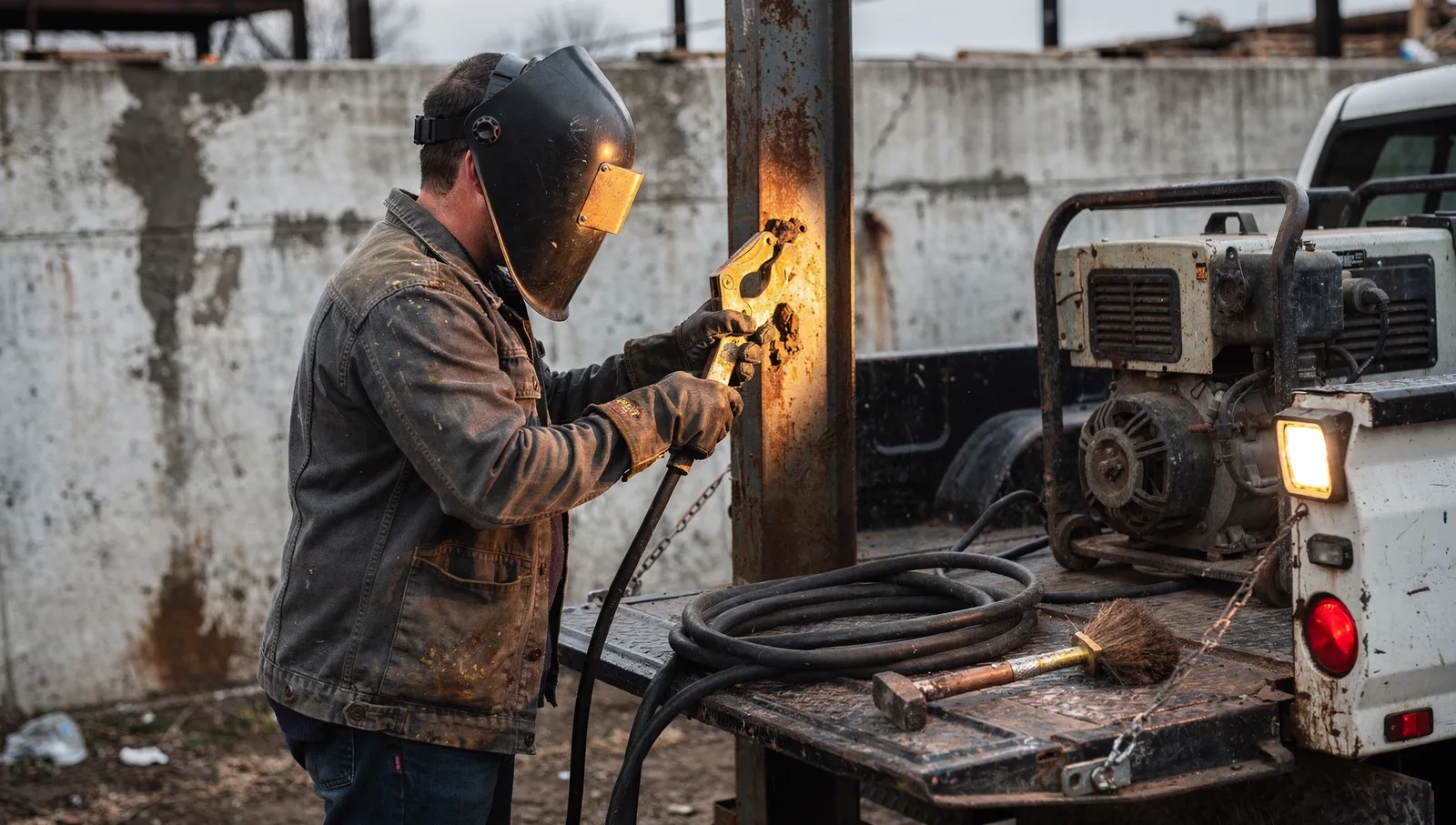
Mobile welding services fill the gap between shop fabrication and on-site assembly. A mobile welder arrives at the job site with equipment, materials, and expertise to make repairs, complete assemblies, or fabricate custom pieces without moving the work to a shop. This flexibility comes with trade-offs in cost, quality control, and lead time.
Hourly Rates and Pricing Models for Mobile Welding#
Mobile welding rates vary widely depending on the welder's experience, the equipment required, the distance traveled, and the job complexity. According to the U.S. Bureau of Labor Statistics, the mean hourly wage for Structural Metal Fabricators and Fitters (occupational code 51-2041) in May 2023 was $24.35, and the median hourly wage was $23.31. These figures represent the welder's base labor cost; the mobile welding rate charged to a customer is typically higher, reflecting the welder's overhead (truck, equipment, insurance, fuel), profit margin, and the premium for on-site availability.
A customer should expect mobile welding rates to vary depending on scope, location, and urgency. Emergency calls (nights, weekends, holidays) command a premium. Routine repairs on a standard material (structural steel, MIG or stick) cost less than exotic work (stainless steel, aluminum, specialized processes). Distance from the welder's base also matters: jobs at a distance incur travel time and fuel cost that nearby jobs do not.
The pricing model also varies. Some mobile welders charge an hourly rate plus materials; others charge a flat fee for a defined scope. For emergency work, an hourly rate with a minimum (e.g., a 2-hour minimum even if the job takes 30 minutes) is common. For a known scope (e.g., "weld a 20-foot railing"), a fixed price is more predictable for the customer. A customer should ask for a quote that specifies the labor rate, the material cost, any travel charges, and the minimum billable time.
Disadvantages of Mobile Welding and When to Use On-Site vs. Shop Fabrication#
Mobile welding is fast and flexible, but it sacrifices some of the quality control and efficiency that a shop offers. The disadvantages are real and should inform the decision of when to use mobile welding and when to ship work to a shop.
Weather and Environmental Control. A shop has climate control, protection from rain and wind, and consistent lighting. A mobile welder works outdoors, where cold slows cooling and can embrittle welds, rain disrupts shielding gas, and darkness requires portable lighting. These conditions do not make sound welding impossible, they make it harder and slower. A joint that takes 30 minutes in a shop might take substantially longer on-site, and the welder must use additional techniques (preheat; wind breaks, post-weld heat treatment) to ensure quality.
Surface Condition. Shop material arrives clean; site material is often rusty, painted, or contaminated. Rust and paint must be removed before welding (wire brushing, grinding, or chemical cleaning), adding time and cost. A mobile welder must carry grinding equipment and be skilled at surface prep under field conditions.
Inspection and Documentation. A shop has fixed inspection equipment (ultrasonic testing machines, dye penetrant kits) and trained inspectors on staff. A mobile welder may not have access to these tools on-site, which means critical joints cannot be inspected to the same standard. For routine repairs, visual inspection may be sufficient; for structural work that must meet building code, the lack of NDT capability is a significant limitation.
Material Availability. A shop stocks common materials (A36 plate, structural shapes, filler wire) and can source specialty materials quickly. A mobile welder must carry materials on the truck or order them in advance, which limits flexibility for change orders or unexpected material needs.
When to Use Mobile Welding. Mobile welding is the right choice when:
- The work cannot be moved (a gate in place, a railing on a building, a structural repair).
- The job is urgent (emergency repair, safety hazard, business interruption).
- The scope is small (a few welds, a quick repair, a custom detail).
- The customer wants to avoid the cost and delay of shipping.
When to Use Shop Fabrication. Shop fabrication is the right choice when:
- The work is large or complex (a multi-piece assembly, a custom structure).
- Quality control and inspection are critical (seismic-resistant building, pressure vessel, bridge).
- The job is routine (standard gates, railings, or frames that the shop has fabricated many times).
- Cost is the primary driver (a shop can batch similar jobs and achieve economies of scale that a mobile welder cannot).
Lead Times, Regional Availability, and Detroit-Area Supply Considerations#
Lead time for structural steel fabrication depends on the complexity of the work, the availability of materials, and the fabricator's backlog. A simple gate might be fabricated in a few days; a complex multi-piece assembly might take weeks. Material lead time is a separate constraint: if the required steel grade or size is not in stock, the fabricator must order it from a mill or distributor, adding days or weeks to the schedule.
The Detroit metro area has a strong regional fabrication industry, with shops concentrated in Wayne, Oakland, and Macomb counties. This proximity is an advantage: material is readily available, and mobile welders can respond quickly to emergency calls. However, the region's fabrication capacity is not unlimited, and during peak construction seasons (spring and summer); lead times can stretch. A customer planning a major project should place orders early and communicate with the fabricator about the schedule.
Response time depends on the current workload and proximity to the job site, but the commitment is to mobilize within hours, not days.
Environmental and Economic Impact of Structural Steel Fabrication#
Structural steel fabrication has measurable environmental and economic impacts that a customer or a specifier should understand. These impacts inform material choices, process decisions, and regional sourcing strategies.
Emissions, Waste, and Sustainability Metrics in Fabrication#
The environmental cost of structural steel begins at the mill (where iron ore is smelted into raw steel) and continues through fabrication (where material is cut, welded, and assembled). The fabrication stage itself contributes a measurable amount of carbon emissions per unit of steel, according to lifecycle assessment data. Transport to the fabricator adds additional emissions. These figures are modest compared to the mill stage, but they are real and measurable.
Fabrication waste is the most visible environmental impact. The material multiplier for structural steel fabrication is such that 1.0771 MT of raw steel input is needed to produce 1 MT of finished product, meaning that a percentage of the material purchased becomes scrap. This scrap is typically recycled (steel is infinitely recyclable), but the energy to melt and re-process it is not free. A fabricator that minimizes waste, through efficient nesting of parts, careful cutting, and reuse of offcuts, reduces both cost and environmental impact.
For a customer specifying structural steel, the choice of grade and the design of the structure affect total material use and thus total emissions. A heavier structure uses more steel and generates more emissions; a lighter, more efficient design uses less. This is where the collaboration between the designer, the fabricator, and the customer matters: a fabricator who understands the design intent can suggest material and process choices that reduce weight without compromising strength or durability.
Employment, Wages, and Regional Fabrication Hubs#
Structural steel fabrication is a skilled trade that supports significant employment and wages in the United States. In May 2023, the U.S. employed 57,810 Structural Metal Fabricators and Fitters; with a mean annual wage of $50,640 and a median annual wage of $48,480. These figures represent solid middle-class employment, higher than many service-sector jobs and comparable to skilled trades like electricians and plumbers.
Regional concentration is pronounced. Texas leads in the number of workers with 6,940 workers, followed by states with strong manufacturing bases like Wisconsin, which employed 3,110 Structural Metal Fabricators and Fitters with a mean annual wage of $51,850. Wisconsin's location quotient (a measure of concentration relative to the national average) is 2.83, indicating the state has above-average concentration of this occupation. This reflects Wisconsin's legacy in heavy manufacturing and its continued strength in fabrication and machinery production.
The Detroit metro area, though not listed separately in the national data, is a significant regional hub for structural steel fabrication, drawing on the region's automotive and manufacturing heritage. The availability of skilled fabricators, established supply chains, and a customer base in construction and industrial sectors make the region competitive for both routine and custom work.
Employment in fabricated metal product manufacturing (NAICS 3323 and 3324) accounted for 25,490 Structural Metal Fabricators and Fitters in May 2023, while ship and boat building (NAICS 336600) employed 5,820 workers; with a mean annual wage of $55,990. The higher wage in ship and boat building reflects the complexity and precision required for marine structures, where tolerances are tighter and inspection standards are more stringent than in typical building fabrication.
Next Steps: Validate Your Fabrication Needs#
Structural steel fabrication is a discipline that demands precision, accountability, and hands-on problem-solving. Whether you are specifying a new gate, repairing a railing, or designing a security cage for an air-conditioner unit, the quality of the fabrication determines whether the structure functions, lasts, and meets code.
Use this framework to evaluate your own situation:
Define the application. Is this a standard structural element (a gate, a railing, a frame) or a custom, non-standard piece? Standard work can be shopped to multiple fabricators; custom work demands a fabricator who understands your site and your constraints.
Assess the urgency. Is this a planned project with weeks of lead time, or an emergency repair that must be completed within hours? Emergency work justifies mobile welding; planned work may benefit from shop fabrication's quality control and cost efficiency.
Specify the material and standard. What steel grade does the application require? What inspection standard applies (AWS D1.1, AISC, building code)? A clear specification prevents disputes and ensures the fabricator delivers what you need.
Evaluate the fabricator's credentials. Does the fabricator have AWS-certified welders? Does it use third-party inspection for critical joints? Can it document its process and prove compliance with the specification? These are the hallmarks of a professional operation.
Get a detailed quote. A quote should specify the labor rate, material cost, inspection method, lead time, and any travel or emergency charges. A vague quote ("we'll call you with a price") is a red flag.
Broken gate, a railing that needs fixing, or a fabrication job? Call or send it over and we will get you a straight, free quote. Mobile and 24-hour emergency service available.
| Steel Grade | Yield Strength | Tensile Strength | Primary Application | Key Fabrication Characteristic |
|---|---|---|---|---|
| ASTM A36 | 36 ksi | 58–80 ksi | Buildings, bridges, machinery frames | Readily welds with standard MIG or stick processes |
| ASTM A572 | 50 ksi | Exceeds A36 | Higher-load applications, weight-critical designs | Requires preheating and controlled cooling to prevent brittle fracture |
| ASTM A588 | High yield (weathering grade) | Exceeds A36 | Outdoor structures without paint | Forms protective rust layer; eliminates protective coating requirement |
| Process Step | What Happens | Quality/Risk Focus | Cost or Timeline Impact |
|---|---|---|---|
| Material Receipt & Inspection | Steel arrives in coils, plates, or beams; certifications verified; dimensions and surface checked | Defects caught early prevent rework or scrap; mill certifications confirm grade and chemistry | Early detection saves hours of delay versus post-weld discovery |
| Cutting & Drilling | Plasma, oxy-fuel, or band-saw cutting to length; bolt holes drilled or punched to precise location | Tolerances tight enough for bolt fit and alignment; loose enough to avoid tool wear | Overage (waste material) represents modest percentage of finished product; affects material cost and environmental footprint |
| Bending & Forming | Cold bending for minor angles; heating for tight radii or thick material; controlled cooling applied | Heat-affected zone brittleness risk if cooling is uncontrolled; stress-relief heat treatment may be required | Non-standard custom designs often require problem-solving; bend radius and available tooling must align with design intent |
| Welding & Assembly | Tack-welds hold position; full welds applied by certified welder (AWS D1.1 standard) using MIG or stick process | Welder certification, process parameters (voltage, wire feed, shielding gas), and joint inspection determine strength and durability | MIG faster and cleaner; stick more forgiving in field conditions or on rusty/painted surfaces |
| Inspection & Testing | Dimensional accuracy verified; visual inspection for defects; ultrasonic testing (UT) or radiography (X-ray) for internal flaws; dye penetrant (DP) for surface cracks | Third-party inspector required by building codes; every inspection documented as permanent record of code compliance | Inspection adds timeline but proves structural integrity and code adherence; failures discovered here require rework |
| Shipping & On-Site Assembly | Fabricated pieces transported to job site; assembled via bolting or field welding into final structure | Weather, rust, paint, mill scale, and site access introduce uncontrolled variables in field welding | Mobile welding expertise and rapid mobilization critical; field conditions require more robust process parameters than shop conditions |
| Category | Count/Metric | Details |
|---|---|---|
| National Employment | 57,810 workers | Occupational code 51-2041; all industries combined |
| Mean Hourly Wage | $24.35 | National average across all employment sectors |
| Median Hourly Wage | $23.31 | 50th percentile; half earn more, half earn less |
| Mean Annual Wage | $50,640 | National average across all employment sectors |
| Median Annual Wage | $48,480 | 50th percentile; reflects typical mid-career earnings |
| Fabricated Metal Product Manufacturing | 25,490 workers | NAICS 3323 and 3324 combined; largest single sector |
| Ship and Boat Building | 5,820 workers | NAICS 336600; mean annual wage $55,990 |
| Texas (Highest-Employing State) | 6,940 workers | Leads all U.S. states in structural metal fabricator employment |
| Wisconsin | 3,110 workers; $51,850 mean annual wage | Location quotient 2.83 (2.83× national average concentration) |
| Impact Category | Magnitude | Scope/Notes |
|---|---|---|
| Fabrication-Stage Global Warming Potential | 0.0967 kg CO₂e per kg steel | Emissions from the fabrication step itself (cutting, bending, welding, etc.) |
| Transport to Fabricator Emissions | 0.0446 kg CO₂e per kg steel | Upstream contribution for shipping raw steel to the fabrication shop |
| Indicative Total Fabrication Impact (FI) | 0.08–0.1 tCO₂e per tonne | Excludes protective coatings; varies with fabrication complexity |
| Fabrication Waste Rate | 7.71% | Extra material needed to account for overage created during cutting and processing |
| Material Multiplier for Mill Input | 1.0771 MT | MT of structural steel produced at mill per 1 MT of fabricated product output; reflects scrap/overage |
| Share of Cradle-to-Fabricator GWP | 8% | Percentage of total global warming potential attributed to fabrication step (AISC industry-wide EPD) |
Structural Steel Fabrication Cost Estimator
Estimates structural steel fabrication cost based on project tonnage, base material price per pound, shop labor hours per ton, shop hourly billing rate, and surface finishing/coating options (primer, powder coat, or hot-dip galvanizing).
Raw Steel Material Cost:
Fabrication Labor Cost:
Surface Finish & Coating Cost:
Estimated Total Fabrication Cost:
Effective Cost per Ton:
Frequently Asked Questions
Why does structural steel fabrication require certified welders and formal inspection when other metal work does not?
Structural steel carries predictable loads, roof snow, vehicle weight; wind forces, that must be proven safe by engineering and testing. Every weld joint in a certified fabricator's assembly becomes part of a permanent inspection record required by building codes and liability law. Uncertified or uninspected welds in load-bearing work violate code and expose the builder to structural failure and liability. Routine metal work (gates, signs, decorative frames) carries no such stakes.
How does the choice between MIG and stick welding affect job cost and timeline?
MIG welding is faster and produces cleaner beads, reducing labor time and rework in controlled shop environments. Stick welding is slower but forgives rusty, painted, or contaminated surfaces and tolerates poor weather, making it standard for field assembly. Shop work typically favors MIG; on-site assembly often requires stick or hybrid processes. The process choice depends on environment and timeline, not material grade alone.
What happens if cutting and drilling tolerances are set too tight?
Excessively tight tolerances accelerate tool wear, increase cutting time, and raise labor cost without improving final assembly quality. Bolts still fit and pieces still align within looser tolerances typical of the industry. Fabricators set tolerances loose enough to be economical yet tight enough to ensure components fit during assembly, overshooting precision wastes money on unnecessary tooling and rework.
How does material waste during fabrication affect both cost and environmental impact?
Cutting and processing create waste (overage) totaling 7.71% of the finished product weight. This waste increases the mill input needed per unit of finished structural steel and drives both material cost and carbon emissions. Higher-grade steels and tighter designs can reduce overage percentage, but eliminating waste entirely is impossible; the fabricator must purchase more raw material than the final assembly weighs.
Why does heating during bending create brittleness risk in high-strength steels but not in A36?
Heat-bending carries that risk for any structural steel: if the steel cools too fast after heating, the heat-affected zone becomes brittle, so controlled cooling or stress-relief heat treatment after forming is the safeguard. A36 is the more forgiving grade to weld, since it welds readily with standard MIG or stick processes, while higher grades such as A572 and A588 require preheating and controlled cooling to avoid brittle fractures.
What is the typical mean annual wage for a Structural Metal Fabricator and Fitter in the United States?
The mean annual wage for Structural Metal Fabricators and Fitters was $50,640 in May 2023, with a median of $48,480. Workers in Ship and Boat Building earned a higher mean of $55,990. Wages vary by industry sector, with fabricated metal product manufacturing employing the largest share of the workforce.
Which U.S. state has the highest concentration of structural metal fabricators relative to the national average?
Wisconsin had a location quotient of 2.83 in May 2023, meaning its concentration of Structural Metal Fabricators and Fitters is 2.83 times the national average. The state employed 3,110 fabricators with a mean annual wage of $51,850. Texas employed the most fabricators in absolute terms (6,940), but Wisconsin shows the highest relative concentration.
Sources
- www.bls.gov (via Perplexity sonar-pro) - BLS (2026-09-06)
- Structural Metal Fabricators and Fitters - BLS (2026-09-06)