
aluminum welding service near Royal Oak Michigan
Short answer
For aluminum welding near Royal Oak, contact Moodt Fabrication (20 minutes away, (248) 520-3639, open Monday-Friday 8AM-5PM) or Capital M Welding & Fabrication in Highland Park ((313) 412-5782, hours 6AM-6PM with 24-hour emergency response available). HotFab Welding also offers mobile services at (248) 259-9956, and Metal Man Mobile Welding serves the Detroit area at (313) 327-4863.
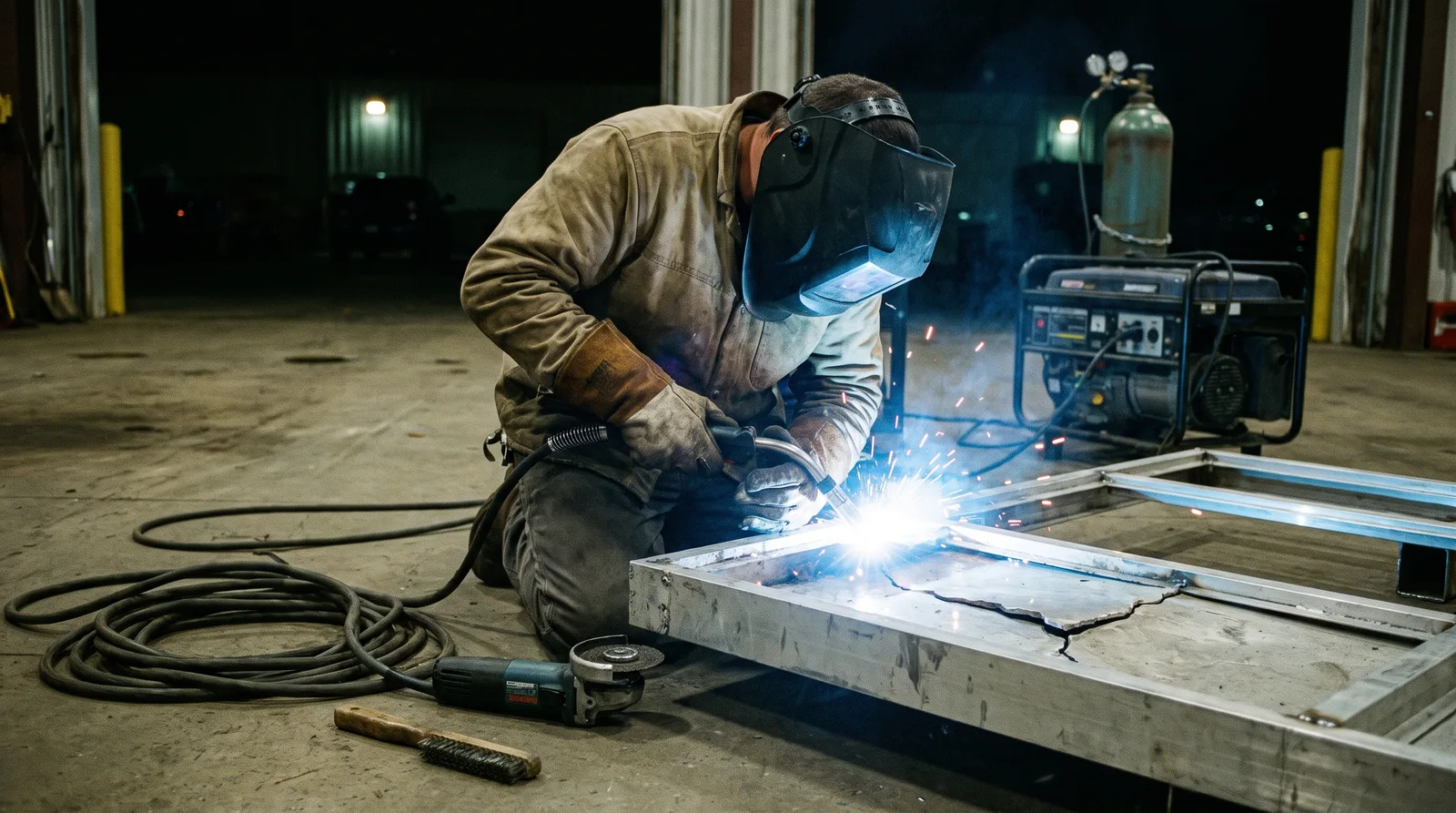
“Welder fabricators are essential to nearly every major industry, combining metalworking skills with design interpretation to build and repair structures, equipment, and products.”
— American Welding Society (AWS)
“Mobile Onsite Welding and Fabrication, located in Pontiac, MI, offers a range of welding and fabrication services, including emergency repairs, custom fabrications, and structural modifications.”
— MapQuest
Why Capital M Welding's 24-Hour Emergency Response Defines Metro Detroit Aluminum Repair#
Aluminum failures do not wait for business hours. A cracked structural beam, a failed railing weld, or a burst fabricated tank can halt production or create a safety liability in minutes, and the cost of downtime, lost throughput, idle labor, liability exposure, compounds faster than the cost of the repair itself. This is where the distinction between a standard welding shop and a mobile emergency service becomes material to a real business outcome.
Capital M Welding & Fabrication operates 24-hour emergency aluminum repair response across Metro Detroit, including Royal Oak. The difference between a shop that closes at 6 PM and one available at midnight is not a convenience; it is the difference between a controlled repair window and an unplanned production halt. When a time-critical aluminum failure occurs, a structural weld that has cracked, a fabricated component that has failed in service, the ability to dispatch a qualified welder with dual-process expertise (MIG and stick) to your site within hours, not days, changes the economics of the failure itself.
The Cost of Delay: Why Time-Critical Aluminum Failures Demand Specialist Response#
Aluminum's high thermal conductivity and low melting point mean that a failed weld or a crack in service can propagate rapidly under load. Unlike steel, which often gives visible warning through deformation before catastrophic failure, aluminum can fail suddenly and completely. A railing weld that has cracked under vibration, a structural bracket that has fatigued, or a tank seam that has begun to leak demands immediate intervention, not because the repair is complex, but because the window to repair safely and prevent cascading damage is narrow.
The cost of delay compounds in three ways. First, production downtime: if the failed component is part of an active process, every hour of repair delay is an hour of lost throughput. Second, secondary damage: a crack in an aluminum structural member under load can propagate, requiring not a simple re-weld but a full replacement of the component. Third, liability: a failed safety-critical component (a railing, a structural support, a pressure vessel) that is not repaired immediately creates exposure. A 24-hour emergency service eliminates the choice between waiting for Monday morning and paying overtime; the repair happens when it is needed.
Mobile vs. Shop-Based: How On-Site Dual-Process Capability Changes the Math#
Mobile on-site welding eliminates transport delay and risk, allows the welder to assess the failure in its actual operating context, and enables diagnosis of root cause that informs repair strategy. A shop-based service requires the failed component to be transported, which introduces delay, risk of further damage in transit, and the cost of logistics. A mobile service brings the welder and equipment to the site and allows the repair to be assessed and executed in the context of the actual installation, critical for structural and pressure-vessel work where fit, alignment, and load path matter.
Aluminum Welding Near Royal Oak: Service Territory, Material Behavior, and Process Selection#
Royal Oak and Metro Detroit Service Territory: What 24-Hour Availability Actually Means#
Royal Oak city, Michigan covers 11.8 square miles and sits at the center of Metro Detroit's manufacturing and fabrication corridor. Capital M Welding & Fabrication serves Royal Oak as part of a broader service territory that includes Detroit, Hamtramck, Ferndale, Warren, Dearborn, Southfield, and Highland Park. The company's base location at 55 Victor Street, Highland Park, Michigan 48203 positions it within a 20 to 30 minute response window for most Royal Oak calls during business hours; 24-hour emergency response means a qualified welder can be dispatched at any hour.
Moodt Fabrication, another regional option, is located 20 minutes from Royal Oak and operates Monday-Friday 8AM-5PM, with Saturday service by appointment. For non-emergency work, custom fabrication, planned repairs, structural projects, shop-based service often offers lower cost and more controlled conditions. For time-critical failures, mobile response is the only option that eliminates delay.
Aluminum vs. Steel: Process Differences, Material Behavior, and Why Your Welder Matters#
Aluminum and steel behave fundamentally differently under heat, and this difference determines which process works and which fails. Steel melts at a significantly higher temperature than aluminum. This temperature gap means that aluminum reaches its melting point long before it shows the color change (red, orange, yellow) that a steel welder relies on to judge heat input. A welder trained only on steel will fail at aluminum due to differences in melting point, oxide behavior, and heat management that demand specialized equipment and process knowledge distinct from steel welding.
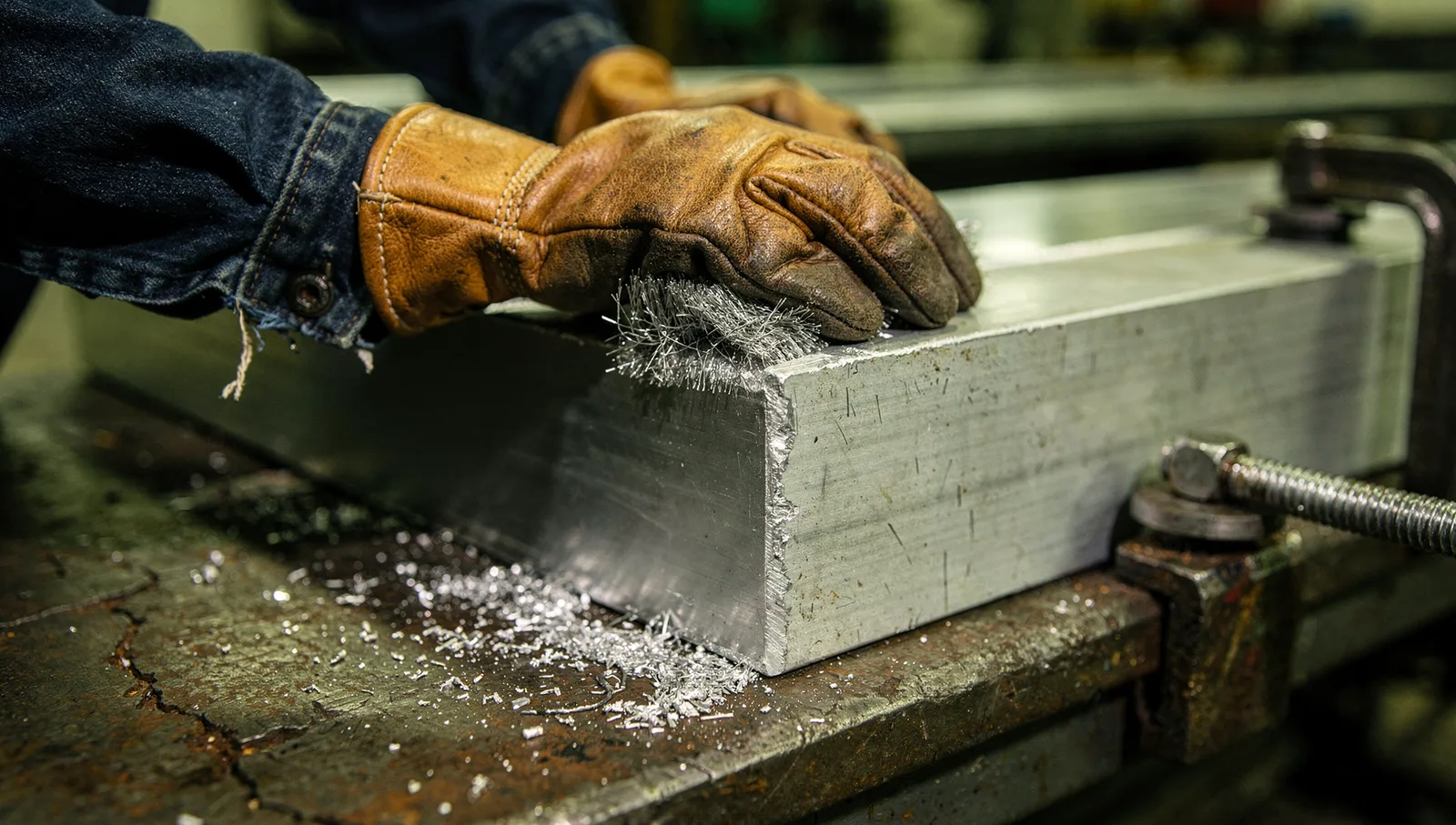
Aluminum also has no visible oxidation layer to signal when the base metal is hot enough to accept filler. Steel oxidation turns black and then bright orange; aluminum oxide is white and invisible to the naked eye at welding temperature. Aluminum oxide must be removed immediately before welding, by wire brushing, chemical cleaning, or mechanical abrasion, to prevent porosity and weld failure.
Aluminum also has high thermal conductivity: heat flows away from the weld zone into the surrounding metal far faster than in steel. This means the heat input must be higher, the travel speed must be faster, and the technique must be more precise to avoid either burning through (too much heat, too slow travel) or creating a cold weld (too little heat, too fast travel). A cold weld in aluminum looks acceptable but has no strength; it will crack under any load.
These fundamental differences in thermal properties, oxide behavior, and heat management are not academic. They are the reason a Harbor Freight welder, a low-cost, single-process machine designed for hobbyist steel work, will not reliably weld aluminum. The machine may have an aluminum setting, but the setting is a wire-feed speed and voltage dial, not a process. A true aluminum MIG welder includes a spool gun (a motor-driven wire feeder mounted on the welding gun itself, not at the machine), a shielding gas regulator tuned for argon or argon-helium mix, and a power supply with sufficient amperage headroom to handle aluminum's high thermal conductivity. Without these, the wire will not feed reliably, the shielding gas will not protect the weld pool, and the weld will be porous and weak.
MIG and Stick Welding for Aluminum: When Each Process is the Right Tool#
MIG (Metal Inert Gas) is the primary and most common process for aluminum work. It uses a continuously fed wire electrode, an inert shielding gas (usually pure argon or argon with helium), and a semi-automatic gun. MIG is fast, produces clean welds with minimal spatter, and is well-suited to thin-wall aluminum sections (sheet, tubing, extrusions). For structural aluminum, decorative aluminum, and most fabrication work, MIG is the default.
Stick welding (Shielded Metal Arc Welding, or SMAW) can weld aluminum, but it is slower, produces more slag, and is less common in modern aluminum work. Stick is used primarily when portability is critical (a stick machine is simpler and more rugged than a MIG setup) or when the joint geometry makes MIG difficult (deep grooves, poor access).
TIG (Tungsten Inert Gas) welding is the highest-quality aluminum process, it produces the strongest, most precise welds and is used for critical structural work, aerospace components, and high-pressure vessels. TIG requires more skill and is slower than MIG, so it is more expensive. For routine repairs and fabrication, MIG is the economic choice; for critical structural work, TIG may be specified.
Structural and Decorative Aluminum Welding: On-Site Fabrication, Turnaround, and Safety Protocols#
Structural Aluminum Repairs vs. Decorative Fabrication: Scope, Equipment, and Workflow#
Structural aluminum work, railings, support brackets, load-bearing frames, pressure vessels, requires documentation, material traceability, and process control. The welder must know the aluminum alloy (6061, 5083, 7075, etc.), because different alloys have different weldability, strength, and heat-treat requirements. A 7075 aluminum alloy, for example, is very strong but difficult to weld and prone to cracking if not heat-treated correctly after welding. A 6061 alloy is easier to weld and is the standard for structural work.
Structural repairs also require a qualified welder (often certified to AWS D1.2, the American Welding Society standard for aluminum) and documented inspection. The repair must be recorded. The weld must be visually inspected and often radiographically inspected (X-rayed) to confirm there are no internal voids, and the component must be proof-tested or load-tested before return to service.
Decorative aluminum work, gates, railings, trim, custom fabrication, has lower structural demands and is often done to visual standards only. A decorative weld must look good and hold together, but it does not need to meet a structural standard or pass radiographic inspection. This allows faster turnaround and lower cost.
On-site fabrication for either type follows a workflow: assessment and material identification, joint preparation (cleaning, fit-up, clamping), welding, inspection, and finish work (grinding, polishing, painting if required). For a structural repair, the assessment phase is critical, the welder must determine whether the failure was due to a weld defect, a design flaw, material fatigue, or corrosion, because the repair strategy depends on the root cause.
Aluminum-Specific Handling and Safety: Why This Matters During Mobile and Emergency Work#
Aluminum is lightweight and non-magnetic, which makes it easy to handle but also creates safety hazards. Aluminum does not stick to a magnet, so magnetic clamps and fixtures do not work; the welder must use mechanical clamps, which require more setup time and care to avoid distorting the component. Aluminum also expands and contracts more than steel under heat, so residual stress and distortion are common after welding. A structural component that is slightly out of square before welding can be significantly out of square after, requiring post-weld straightening.
Aluminum also conducts electricity well, so grounding and electrical safety are critical. A wet aluminum component or a welder standing in water while welding aluminum is a serious shock hazard. Mobile work often occurs in less-controlled environments (outdoors, in wet conditions, in tight spaces), so electrical safety discipline is essential.
Aluminum dust and fumes are also a concern. Aluminum oxide dust (created during grinding or wire brushing) can accumulate in the lungs and cause a condition called "metal fume fever" if inhaled in high concentrations. A welder working on aluminum should use respiratory protection (a dust mask for grinding, a supplied-air respirator for high-volume work) and ensure good ventilation. In a mobile setting, ventilation is often limited, so respiratory protection becomes more important.
On-Site Fabrication and Turnaround: From Assessment to Completed Weld#
A typical on-site aluminum repair follows this sequence:
- Assessment: The welder inspects the failed component, identifies the alloy (by visual inspection, material marking, or chemical test), and determines the failure mode (crack, corrosion, fatigue, design flaw).
- Material and equipment check: The welder confirms that the required filler material (MIG is the primary process for aluminum work, and the welder selects the appropriate MIG wire or, when portability or joint geometry demands it, stick electrode) and shielding gas are on hand and appropriate for the alloy, covered above in process selection.
- Joint preparation: The failed area is cleaned (with oxide removed by wire brushing, chemical cleaning, or mechanical abrasion to prevent porosity and weld failure, covered above in material behavior), and the joint is fit up and clamped.
- Welding: The weld is executed using the appropriate process (MIG or stick), with heat input and travel speed controlled to avoid burn-through or cold welds.
- Inspection: The weld is visually inspected for cracks, porosity, and undercut. For structural work, radiographic inspection may be required.
- Finish work: The weld is ground smooth, painted if required, and the component is returned to service or proof-tested.
For a simple repair (a cracked railing weld, a loose bracket), this process takes a few hours. For a complex structural repair (a pressure vessel, a load-bearing frame), it may take a full day or more. On-site work allows the welder to assess the failure in its actual operating context and enables diagnosis of root cause that informs repair strategy, eliminating transport time and allowing the component to return to service immediately.
Aluminum Welding Cost and Transparent Quotation: What You're Actually Paying For#
Pricing Models: What Aluminum Welding Actually Costs and How to Compare#
Aluminum welding pricing depends on several factors: the alloy, the joint complexity, the process (MIG or stick), whether the work is on-site or shop-based, and whether inspection or certification is required. A simple decorative weld on a gate or railing costs considerably less than a structural repair on a pressure vessel or load-bearing frame.
A transparent quote should itemize the following:
- Material cost: The cost of the filler wire or electrode, shielding gas, and any consumables (contact tips, nozzles, liners).
- Labor cost: The hourly rate for the welder, multiplied by the estimated time to complete the repair.
- Equipment and travel: For mobile work, the cost of dispatch, travel time, and equipment setup.
- Inspection and certification: If required, the cost of radiographic inspection, testing, or AWS certification.
- Finish work: Grinding, polishing, painting, or other post-weld finishing.
A shop-based service may quote a flat rate for a standard job (a gate repair, a bracket re-weld) or an hourly rate for custom work. A mobile service typically quotes hourly labor plus material and travel. The key is to understand what is included in the quote and what is not, some quotes include travel time, others charge it separately; some include finish work, others do not.
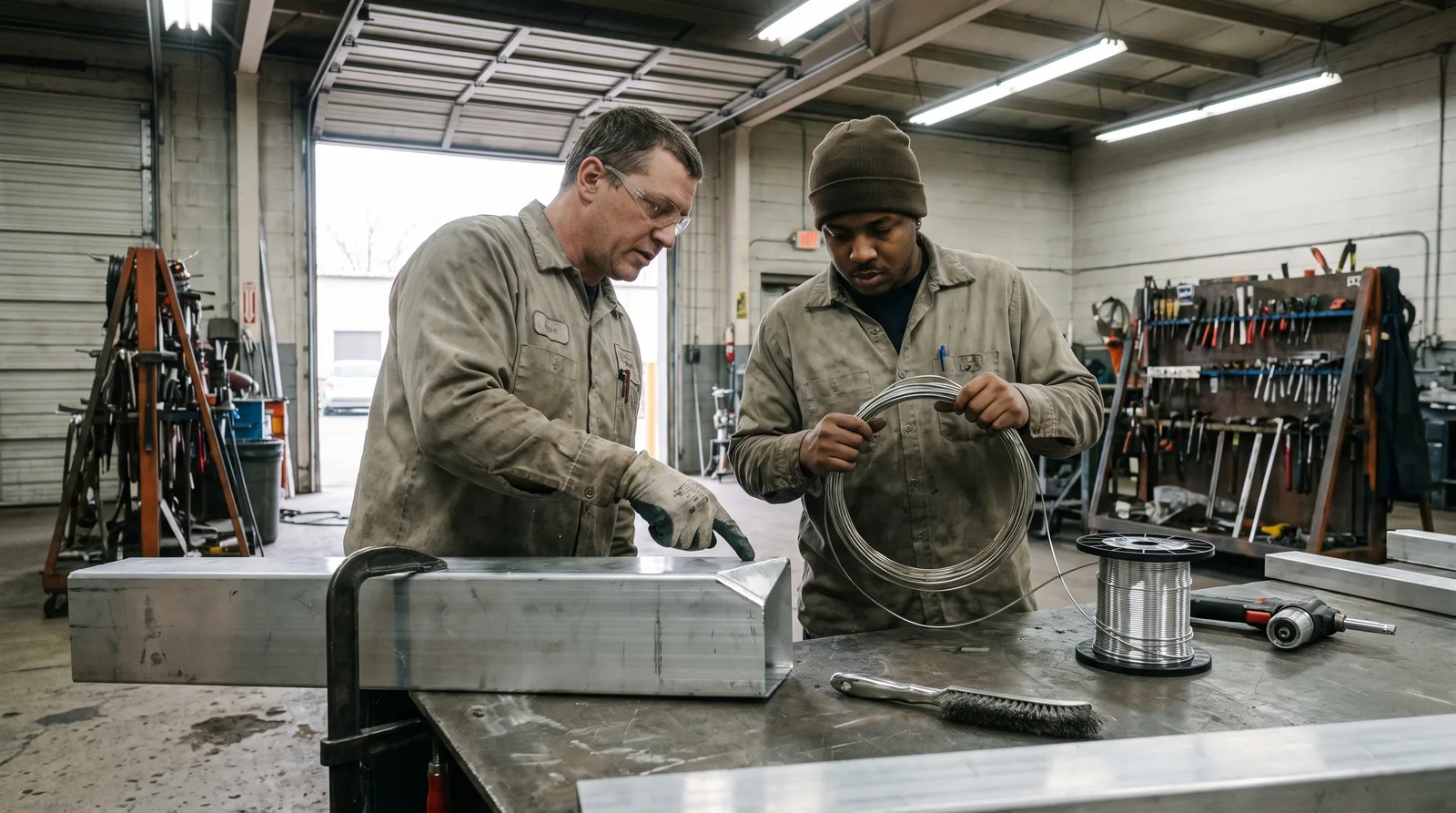
When comparing quotes from different providers, ensure you are comparing the same scope. A low quote that excludes inspection or finish work is not a true comparison to a higher quote that includes both. Ask each provider to itemize their quote and to specify the alloy, the process, the inspection method, and the warranty or guarantee on the work.
Why Harbor Freight and Budget Equipment Struggle With Aluminum: Material Reality, Not Marketing#
Proper aluminum MIG welding equipment requires specific features that reflect material physics, not marketing.
A true aluminum MIG welder requires:
- A spool gun: A motor-driven wire feeder mounted on the welding gun, not at the machine. Aluminum wire is soft and deforms easily, so it cannot be pushed through a long cable from a remote feeder (as steel wire can). The spool gun keeps the wire path short and rigid.
- A high-amperage power supply: Aluminum's high thermal conductivity means the welder must use higher amperage than steel to achieve the same penetration. A 140-amp machine (common on budget welders) is marginal for aluminum; a 200-amp machine is more practical.
- Argon or argon-helium shielding gas: Aluminum requires an inert gas (not CO2, which is used for steel). The gas regulator must be tuned for the correct flow rate and pressure.
- Proper wire and consumables: Aluminum wire is different from steel wire (softer, different diameter, different alloy). The contact tip, nozzle, and liner must be sized for aluminum wire.
Without the spool gun, the high amperage, and the correct gas, the machine will not feed the wire reliably, will not shield the weld pool, and will produce a porous, weak weld. A welder who tries to use a budget machine on aluminum will spend more time troubleshooting wire feed and shielding gas problems than actually welding, and the result will be a weld that looks acceptable but fails under load.
The cheapest way to weld aluminum is not to buy a budget machine and try to make it work. It is to hire a qualified aluminum welder with proper equipment. The cost of a failed weld (rework, liability, downtime) far exceeds the cost of the repair done right the first time.
Transparent Quotes and Facility Capabilities: What Professional Service Requires#
A professional aluminum welding service should be able to provide:
- Material traceability: The ability to identify the aluminum alloy, confirm its properties, and select the correct filler material.
- Process documentation: A record of the welding parameters (amperage, voltage, travel speed, shielding gas), the welder's name and certification, and the date of the work.
- Inspection capability: Visual inspection as standard; radiographic inspection or other non-destructive testing if required.
- Facility and equipment: A shop or mobile setup with proper ventilation, grounding, and safety equipment; a welder trained and certified in aluminum welding.
- Warranty or guarantee: A commitment that the weld will hold under the specified load and service conditions, with a defined remedy if it does not.
Capital M Welding & Fabrication operates from a facility at 55 Victor Street, Highland Park, Michigan 48203, with standard hours 6 AM-6 PM and 24-hour emergency response. The company serves Royal Oak and surrounding areas with both shop-based and mobile capabilities, allowing it to handle both planned fabrication work and time-critical emergency repairs.
When requesting a quote, provide as much detail as possible: the aluminum alloy (if known), the size and weight of the component, the nature of the failure or repair, the required timeline, and any inspection or certification requirements. A detailed quote from a qualified provider will be more accurate and will set clear expectations for the work.
Next Steps: Getting a Straight Quote and Scheduling Your Repair#
A broken gate, a railing that needs fixing, or a fabrication job that cannot wait for Monday morning demands a welder who understands aluminum's material behavior, has the right equipment, and can respond when you need them. The difference between a qualified aluminum welder and a generalist is not a matter of opinion, it is the difference between a weld that holds and one that fails.
Start by documenting the failure or repair need: take photos, note the alloy if visible, and describe the service conditions (is it structural, decorative, indoors, outdoors, subject to vibration or load). Call Capital M Welding & Fabrication at (313) 412-5782 or contact Moodt Fabrication at (248) 520-3639 with the details. A qualified welder will assess the scope, provide a transparent quote that itemizes material, labor, and any inspection or finish work, and commit to a timeline.
For emergency repairs outside standard hours, Capital M Welding's 24-hour response means you do not have to choose between waiting and paying premium rates, the repair happens when it is needed, at a rate that reflects the service, not the desperation. Either way, a straight quote and a clear understanding of what is included will let you compare options and make a decision based on value, not just price.
| Service Provider | Location | Phone | Hours | Specialization |
|---|---|---|---|---|
| Capital M Welding & Fabrication | 55 Victor Street, Highland Park, MI 48203 | (313) 412-5782 | 06:00 am, 06:00 pm (24-hour emergency response available) | Mobile emergency aluminum repair, dual-process capability |
| Moodt Fabrication | 1100 Cesar E Chavez Ave, Pontiac, MI 48340 (20 minutes from Royal Oak) | (248) 520-3639 | Monday-Friday: 8AM-5PM; Saturday: By Appointment | Shop-based welding & fabrication |
| Metal Man Mobile Welding | Detroit area | (313) 327-4863 | Not specified | Mobile welding services |
| HotFab Welding | Metro Detroit service area | (248) 259-9956 | Emergency line available | Mobile on-site emergency welding |
| Factor | Shop-Based Service | Mobile Emergency Service |
|---|---|---|
| Response Time | Component must be transported; repair scheduled during business hours | Welder dispatched to site at any hour; minimal delay |
| Assessment Capability | Component evaluated disconnected from installation context | Failure assessed in situ; root cause diagnosis on-site possible |
| Transport Risk | Risk of damage in transit; logistics cost added | No transport risk; repair executed in operational context |
| Cost Structure | Lower hourly rate but longer timeline and logistics overhead | Higher rate offset by elimination of downtime and secondary damage |
| Structural/Pressure Work | Limited, component removed from operating context | Ideal, fit, alignment, and load path evaluated in place |
| Property/Challenge | Steel | Aluminum |
|---|---|---|
| Melting Point & Heat Indication | Higher melting point; color change signals readiness | Lowers melting point before color change visible; risk of burnthrough |
| Oxidation Layer | Black then orange; visible signal of temperature | White oxide invisible at welding temperature; traps gas if not removed |
| Oxide Removal Requirement | Can skip oxide removal; passable weld often possible | Must remove oxide immediately before welding or porosity results |
| Thermal Conductivity | Lower; heat contained near weld zone | High; heat escapes rapidly into surrounding metal, demands higher heat input |
| Failure Behavior Under Load | Often deforms visibly before failure | Can fail suddenly and completely with little warning |
| Welder Training Requirement | Standard stick or MIG training sufficient | Aluminum-specific dual-process expertise (MIG and stick) required |
Aluminum Welding Job Cost Estimator
Estimates total welding and fabrication costs based on hourly service type rates (standard shop, mobile on-site, or 24/7 emergency dispatch), estimated job duration, and materials/consumables.
Estimated Labor Cost:
Total Estimated Job Cost:
Frequently Asked Questions
What aluminum welding services are available near Royal Oak, Michigan?
Capital M Welding & Fabrication serves Royal Oak from Highland Park with 24-hour emergency aluminum repair and standard business hours 06:00 am-06:00 pm at (313) 412-5782. Moodt Fabrication, 20 minutes from Royal Oak, offers shop-based service Monday-Friday 8AM-5PM at (248) 520-3639. Metal Man Mobile Welding and HotFab Welding also provide mobile aluminum services in the Metro Detroit area.
What is the advantage of 24-hour emergency mobile welding compared to standard shop hours?
24-hour response eliminates the choice between production downtime and expensive overtime. A time-critical aluminum failure, a cracked structural weld, a failed railing, a leaking tank seam, can propagate rapidly under load. Immediate on-site repair prevents cascading damage, avoids liability exposure from unrepaired safety-critical components, and stops lost throughput. Shop closures force delay or expensive emergency callbacks.
Why can't a welder trained on steel successfully weld aluminum?
Aluminum has no visible color change before melting, so a steel welder will overheat it or burn through it before realizing the metal is molten. Aluminum oxide is invisible at welding temperature and traps gas that creates porosity if not removed immediately before welding. Aluminum's high thermal conductivity requires higher heat input and faster travel speed than steel. These differences demand aluminum-specific expertise, typically dual-process capability in MIG and stick welding.
What is the main disadvantage of mobile welding services?
Mobile services typically charge higher hourly rates than shop-based work due to dispatch, travel, and on-site setup costs. However, this premium is often offset by elimination of transport logistics, reduced downtime, prevention of secondary damage, and on-site diagnosis, meaning the true cost-benefit depends on whether the repair is time-critical or routine.
When should I choose shop-based welding over mobile for aluminum work?
Choose shop-based service for non-emergency work: custom fabrication, planned repairs, and structural projects where scheduling is flexible. Shops offer lower hourly rates and more controlled conditions. Mobile emergency service is essential only when a failure is time-critical and the cost of downtime exceeds the mobile service premium.
Why does aluminum fail suddenly under load while steel often shows warning signs?
Steel typically deforms visibly before catastrophic failure, giving warning. Aluminum's material properties allow sudden, complete failure with little visible deformation. A cracked aluminum railing, fatigued bracket, or leaking tank seam can propagate rapidly under load with no advance notice. This is why time-critical aluminum repairs demand immediate intervention, the window to prevent total failure is narrow.
What can a mobile welder diagnose on-site that a shop-based service cannot?
A mobile welder can assess failures within their actual operating environment, examining alignment, fit, and load conditions to identify root causes like fatigue or corrosion. This context reveals whether a simple repair will work or if replacement or reinforcement is needed. Shop-based welders only see the isolated failed part without understanding how it functioned in its original setting.
What emergency mobile welding services are available in Detroit?
Capital M Welding & Fabrication offers 24-hour emergency repair response for aluminum failures across Metro Detroit, including the Detroit area. The company is located at 55 Victor Street, Highland Park, Michigan 48203 and can be reached at (313) 412-5782. Additionally, Metal Man Mobile Welding provides emergency mobile welding services in the Detroit area at (313) 327-4863, and HotFab Welding offers emergency mobile welding services with a phone number of (248) 259-9956.
What makes aluminum welding different from steel welding and why does it matter?
Aluminum has high thermal conductivity and a low melting point, causing failed welds or cracks to propagate rapidly under load. Unlike steel, which typically shows visible deformation as warning before failure, aluminum can fail suddenly and completely. This difference matters because the failure window is narrow and requires immediate repair to prevent cascading damage, secondary structural failure, and safety liability. Time-critical aluminum failures demand rapid specialist response to assess whether a simple re-weld will hold or whether the component requires replacement or reinforcement.
Sources
- Royal Oak city, Michigan - Census Bureau Profile - Data (2026-09-07)
- Mobile On-Site & Emergency Welding in Metro Detroit | HotFab Welding | HotFab Welding — Warren, MI - Hotfabwelding (2026-09-07)
- Expert Welding and Fabrication Services | Capital M Welding - Capitalmwelding (2026-09-07)
- Mobile Welding & On-Site Repair Services in Detroit & Westland, MI | Metal Man Mobile Welding - Metalmanweldingdetroit (2026-09-07)
- Welding & Metal Fabrication Royal Oak, MI | Moodt Fabrication - Moodtfabrication (2026-09-07)
- Mobile Onsite Welding And Fabrication, 714 ETennyson Ave, Pontiac, MI 48340, US - MapQuest - Mapquest (2026-09-07)