
Custom Driveway Gates in Metro Detroit: Styles, Materials, and What to Know
Short answer
Custom driveway gates in Metro Detroit range from $1,500-$6,000+ for standard installed systems to $7,500 to $15,000+ for custom steel designs. A basic aluminum swing gate costs $2,500-$5,500, while material alone runs $2,000-$9,000. Installation labor adds $1,200 to $6,000. Permits and electrical work are separate line items. On-site fabrication eliminates supply-chain delays and allows real-time field modifications.
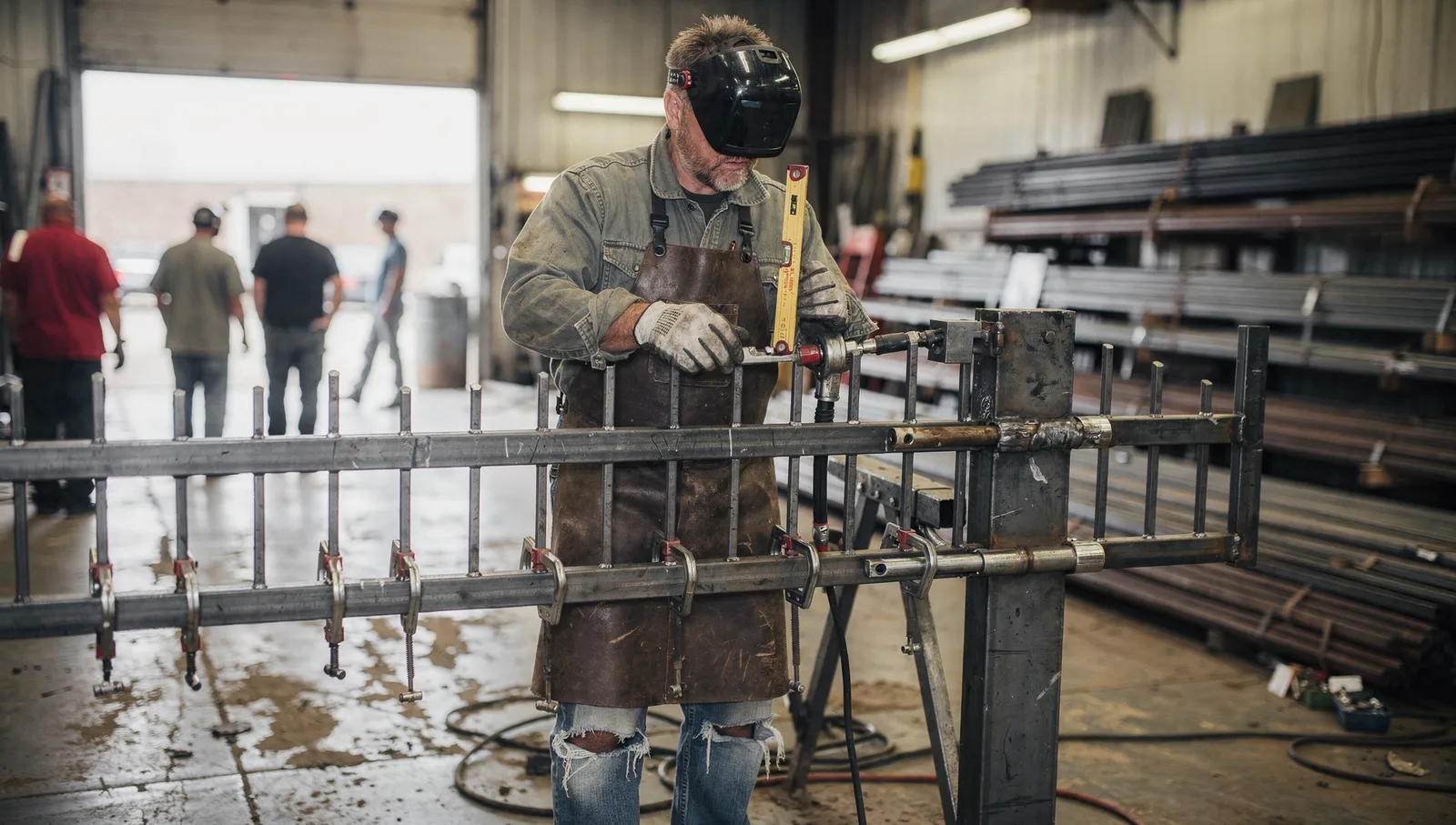
“A fence is only as good as the hole you walk through.”
— BH Fencing
Custom Driveway Gates in Metro Detroit: Styles, Materials, and Pricing#
A custom driveway gate is a fabricated entry system designed to your property's width, height, and aesthetic, installed at your site and integrated with automation, electrical controls, and local permitting. In Metro Detroit, the decision between a shipped pre-manufactured gate and an on-site fabricated one hinges on a single economic reality: supply-chain delays and mid-installation design changes cost more than local fabrication, and winter durability demands materials and reinforcement that generic shipped units do not provide.
Steel Gate Types and Configurations for Residential Properties#
Steel driveway gates come in three primary configurations: single-swing, dual-swing, and sliding. A single-swing gate pivots on one hinge post and suits properties where one side of the driveway can accommodate the swing arc; dual-swing gates split the opening between two leaves, each pivoting inward or outward, and work on narrower driveways or where symmetry matters aesthetically. Sliding gates roll along a track parallel to the fence line and require no swing clearance, making them ideal for tight spaces or steep grades.
The structural choice depends on your driveway width and the automation you plan. A standard single-leaf aluminum or steel gate with automatic opener typically costs $4,000-$9,000. A paired swing setup or longer entry gate typically costs beyond $12,000. Steel is the default for custom work because it accepts welding reinforcement for freeze-thaw durability and can be fabricated to exact dimensions on-site, whereas aluminum shipped gates arrive pre-sized and cannot be field-modified without compromising their integrity.
Mitch, Owner & Lead Welder at Capital M Welding and Fabrication, has found that the gate type decision is not primarily aesthetic, it is a function of your lot geometry and whether you can afford the downtime of a shipped gate sitting in a warehouse while your driveway remains open. Single-swing gates are fastest to install; dual-swing gates require more precise hinge alignment and cost more labor; sliding gates demand a level track and more electrical complexity but eliminate swing-arc conflicts with parked cars or landscaping.
Materials, Finishes, and Winter-Weather Durability#
Steel gates in Metro Detroit must withstand freeze-thaw cycles, salt spray from winter road treatment, and temperature swings that crack welds and corrode fasteners. The material cost for a complete gate varies based on steel grade and finish specifications, and the finish you choose determines how long that investment lasts before rust requires repair.
Hot-dip galvanizing is the standard finish for residential steel gates in Michigan because it provides superior corrosion resistance and durability in freeze-thaw cycles with minimal maintenance. The process submerges fabricated steel in molten zinc, creating a metallurgical bond that protects the underlying metal even where the coating is scratched. Galvanized gates resist salt and moisture for extended periods with minimal maintenance. Powder-coat finishes (epoxy or polyester applied electrostatically and cured in an oven) offer color choice and a smoother appearance but require annual inspection for chips and touch-up; once the coating is breached, rust begins underneath and spreads beneath the remaining coating, making repair difficult.
Marine-grade aluminum costs more than standard materials and is used for large-scale estate gates where corrosion resistance and weight matter. Aluminum does not rust but can corrode in salty environments, and it is softer than steel, so it dents more easily and cannot be welded with the same structural reinforcement steel accepts. For Metro Detroit residential gates, steel with hot-dip galvanizing is the economic choice: it costs less upfront, accepts structural reinforcement for freeze-thaw durability, and lasts longer with lower maintenance.
Stainless steel is rarely used for residential gates because the cost (roughly double galvanized steel) is justified only in marine or chemical-exposure environments. In Metro Detroit's climate, galvanized steel delivers exceptional durability at a price point.
Custom Sizing, Design Options, and Installation Costs#
Custom sizing is where on-site fabrication earns its premium. Shipped gates arrive in fixed, pre-sized dimensions and cannot be field-modified without compromising integrity or voiding warranty; on-site fabrication builds to exact measurements, eliminating gaps and the risk of binding or misalignment.
Design options range from simple vertical-bar or horizontal-slat patterns to ornamental wildlife, tree, or geometric motifs. Tier 1 custom steel gates with standard or semi-custom design cost $7,500-$10,000. Tier 2 "Signature" Series dual-swing or sliding gates with wildlife and tree designs cost $10,000-$15,000. Tier 3 "Elite" Class large-scale estate gates, often marine-grade aluminum, cost $15,000+. These tiers reflect design complexity, material grade, and automation integration; a simple vertical-bar gate at the low end of Tier 1 costs less than an ornamental dual-swing with custom wildlife cutouts.
Installation labor costs vary depending on site prep (concrete footings, hinge post installation, grading), gate weight, and automation integration. Electrical and wiring for an automatic opener run $300-$2,000. Operator and controls (the motor, sensors, and access hardware) cost $800-$4,000. A typical cost range for a complete driveway gate solution is $4,000 to $12,000+.
The per-foot cost for gate material ranges from $20-$80 plus installation and electrical work with automation. Custom steel gates start at $7,500, reflecting the labor and design work; the average client investment for custom premium gates is $10,000 to $15,000+.
Permits, DIY Installation, and Professional Service Areas#
Permits and inspections cost $50-$1,000, depending on your municipality. Metro Detroit jurisdictions vary: some require a building permit for any gate taller than the typical residential height; others require electrical permits only if the gate is automated. Your city or township building office publishes the current schedule and inspection requirements. Delaying the permit application is a common mistake; a gate installed without a permit can trigger a stop-work order and fines, and it may not pass a property sale inspection.
DIY installation is not recommended because hinge posts must be set below the frost line to prevent heaving, welded joints require proper technique to handle structural load and freeze-thaw stress, and automation wiring must meet electrical code and integrate with your access system (keypad, remote, intercom). A professional installation includes site survey, frost-line footings, precision alignment, welding inspection, and electrical testing, all of which are difficult to verify yourself and costly to repair if wrong.
Capital M Welding and Fabrication serves Detroit, Hamtramck, Ferndale, Royal Oak, Warren, Dearborn, Southfield, and Highland Park with on-site fabrication and installation. Typical walk gates in the Metro Detroit market have an installed cost range of $400-$1,200. Professional installation includes a site assessment, frost-line footings, welding inspection, and a warranty on the fabrication and installation labor.
On-Site Fabrication and Mobile Emergency Repair: Why Local Control Matters in Metro Detroit#
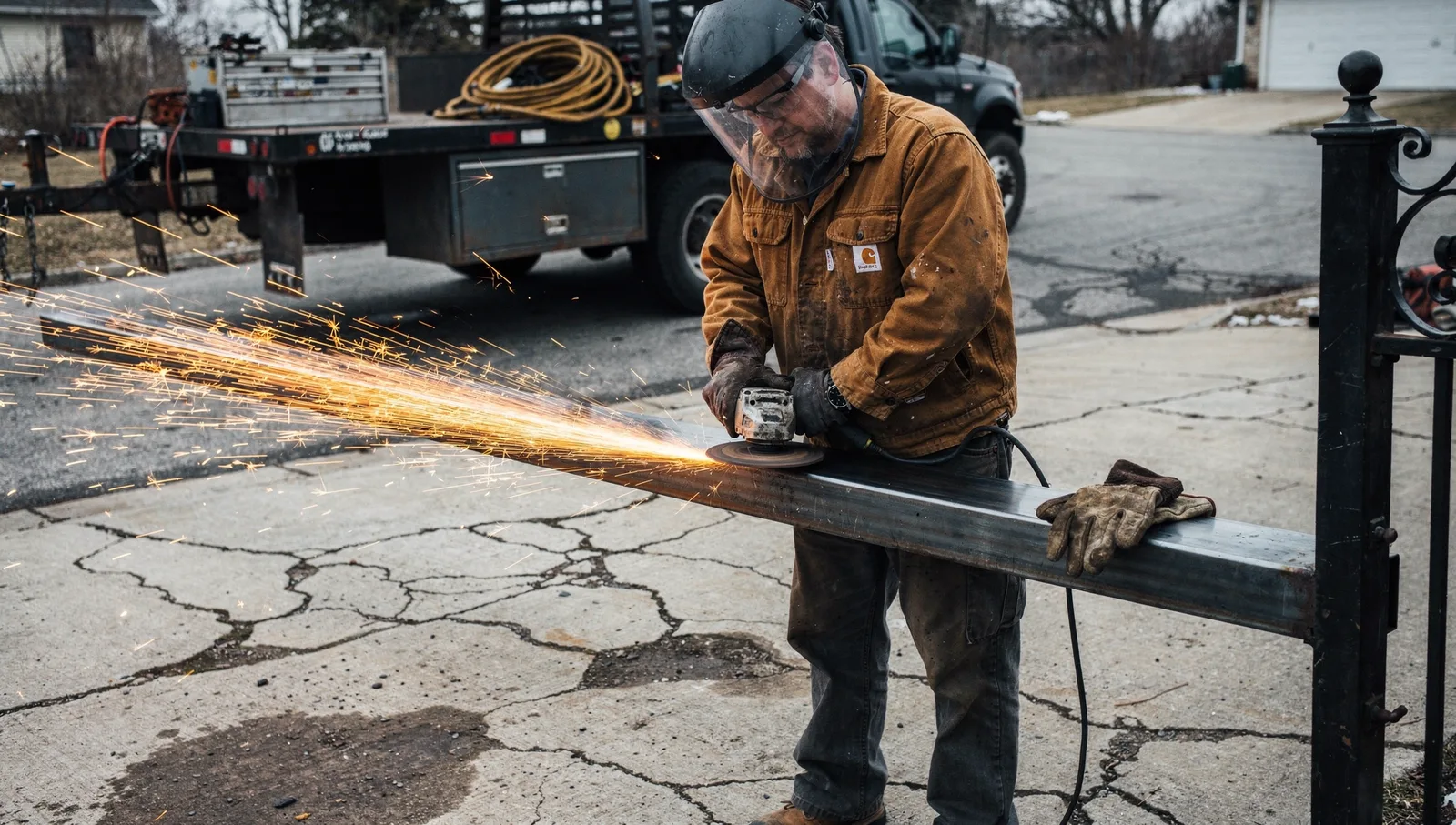
The supply-chain and customization problem with shipped gates is not theoretical, it is a cost equation. A shipped gate takes several weeks to arrive, arrives pre-sized to a standard dimension, and cannot be modified in the field without cutting and re-welding, which voids the manufacturer's warranty and introduces new failure points. If your driveway is 15 ft 3 in. and the gate is 15 ft, you have a gap. If it is 16 ft, it does not fit. If the hinge posts are not perfectly plumb, the gate binds. If the electrical connection is wrong, the opener does not work. You are stuck waiting for the manufacturer's support line or paying a local welder to fix problems that should not exist.
The Supply-Chain and Customization Problem with Shipped Gates#
Shipped gates are manufactured to stock dimensions (typically in standard sizes) and arrive with pre-drilled hinge holes and pre-welded frames. If your driveway does not match a stock size, you have three bad options: buy the next size up and have it cut (expensive and risky), buy the smaller size and live with a gap, or wait for a custom order, which costs more and takes longer. Once the gate arrives, field modifications are nearly impossible. A welder can cut and re-weld, but that introduces new stress points, and the warranty is gone.
Electrical integration is another pinch point. A shipped gate comes with a generic operator and control box; integrating it with your existing intercom, keypad, or smart-home system requires a local electrician to reverse-engineer the wiring and reprogram the logic. If the integration fails, you are troubleshooting between the gate manufacturer, the electrician, and your smart-home vendor, none of whom take responsibility for the other's work.
Winter durability is the third problem. A shipped gate arrives galvanized, but hinge posts, fasteners, and welds may not meet the same standard as on-site fabrication, covered above, where marine-grade fasteners, additional corrosion protection, and reinforced welds handle Michigan's freeze-thaw cycle reliably.
On-Site Fabrication Advantage: Real-Time Modifications and Local Control#
On-site fabrication offers advantages over shipped gates: real-time modifications for exact site fit, site-specific customization for local climate and conditions, and lower total cost of ownership despite higher initial material costs. The gate is built at your property or in a local shop, measured to your exact driveway width, and installed with real-time adjustments. If the hinge posts are not perfectly plumb, the fabricator adjusts them before welding. If the electrical connection needs to integrate with your intercom, the fabricator coordinates with your electrician on-site. If the design needs a modification, a tighter spacing between bars, a different ornamental pattern, a reinforcement for a steep grade, it is done immediately, not shipped back to a factory.
Real-time customization also means the gate is built to your site's specific conditions. A driveway on a slope requires different hinge geometry and reinforcement than a level one. A gate exposed to salt spray (near a road or in a flood-prone area) needs additional corrosion protection. A gate in a high-wind area needs structural bracing. A local fabricator sees the site, understands the climate, and builds accordingly. A shipped gate is built to generic standards and hopes for the best.
You also have a local contact if something breaks, not a customer-service line in another state.
24-Hour Mobile Emergency Repair and Winter Readiness#
A gate that fails in winter is a security and access problem. A stuck gate in a snowstorm, a broken hinge in freezing rain, or a corroded fastener that seizes are not inconveniences, they are emergencies. Capital M Welding and Fabrication offers 24-hour mobile emergency repair service in Metro Detroit, meaning a welder can arrive on-site to diagnose and repair the gate without waiting for a parts order or a factory technician.
Winter readiness means inspecting the gate in fall, replacing corroded fasteners, re-galvanizing exposed welds, and testing the opener in cold weather. A gate that works fine in summer may fail in winter if the lubricant in the hinge freezes, the electrical connections corrode, or the concrete footings heave. A local fabricator knows these failure modes and can prevent them with preventive maintenance.
Emergency repair is also faster and cheaper than replacement. A broken hinge can be welded or replaced in hours; a corroded fastener can be cut and replaced; a stuck opener can be diagnosed and repaired on-site. A shipped gate that fails requires weeks of waiting and thousands of dollars in replacement cost. A local relationship with a fabricator means you have a phone number to call and a welder who knows your gate's history and can fix it the same day.
Welding Process Selection and Structural Reinforcement for Michigan Winters#
The choice between MIG welding and stick welding for a driveway gate is not about preference, it is about durability in freeze-thaw cycles. MIG (Metal Inert Gas) welding uses a wire electrode and shielding gas to create a fast, clean weld; it is the default for light fabrication and is faster than stick. Stick welding (Shielded Metal Arc Welding, or SMAW) uses a consumable electrode coated in flux; it is slower but creates a denser, more ductile weld that handles stress better.
MIG vs. Stick Welding: Which Method Ensures Long-Term Durability#
MIG welding is faster and produces a cleaner bead, making it ideal for ornamental gates where appearance matters. A MIG welder can lay down a bead in one pass, and the weld cools quickly. For a gate with decorative cutouts or fine detail work, MIG is the right choice.
Stick welding is slower but creates a weld with higher tensile strength and better penetration into the base metal. A stick weld cools more slowly, allowing the metal to anneal (relieve internal stress) rather than harden suddenly. In freeze-thaw cycles, a slowly cooled, annealed weld is less likely to crack than a fast-cooled MIG weld. Stick welding also works better in windy or damp conditions because the flux coating shields the weld from moisture and air, whereas MIG requires a steady shielding gas that can be disrupted by wind.
For a structural gate frame in Michigan, stick welding is the better choice for the main load-bearing joints (hinge posts, frame corners, reinforcement bars). MIG can be used for ornamental details or secondary joints. A hybrid approach, stick for structure, MIG for detail, combines the durability of stick with the speed and appearance of MIG.
Structural Steel Reinforcement for Freeze-Thaw Cycles#
Freeze-thaw durability requires more than the right welding process; it requires structural reinforcement that a shipped gate does not have. When water enters a crack or a porous weld, it freezes and expands, pushing the metal apart. Repeated freeze-thaw cycles widen the crack until the weld fails. A reinforced gate resists this by minimizing stress concentration and using materials that can flex slightly without cracking.
Structural reinforcement for Michigan winters includes diagonal bracing in the gate frame (an X or K pattern of steel bars welded to the frame to distribute load and reduce deflection), thicker gauge steel in the hinge posts (meeting structural standards for high-load applications rather than standard thin-wall stock), and additional welds at stress points (corners, hinge attachment, automation bracket). A reinforced gate weighs more and costs more to fabricate, but it lasts for decades instead of a shorter lifespan.
Fasteners also matter. A shipped gate often uses standard bolts and nuts, which corrode and seize in winter. A reinforced gate uses stainless steel or galvanized fasteners, and critical joints are welded rather than bolted. Welding eliminates the fastener corrosion problem and creates a stronger joint.
MIG and stick welding discipline exists precisely to close this gap between a generic shipped gate and a durable, site-specific one. The choice of process, the quality of the weld, and the structural reinforcement determine whether a gate lasts a typical residential lifespan in Michigan's climate.
Gate Automation, Security, and Professional Installation#
Operator Compatibility and Automation Options#
A gate operator is an electric motor that opens and closes the gate; it is the difference between a manual gate you open by hand and an automated one you open with a remote, keypad, or phone. Operator and controls cost $800-$4,000, depending on the motor type, control logic, and integration with your access system.
There are two main operator types: swing operators (for single or dual-swing gates) and sliding operators (for sliding gates). Swing operators use a hydraulic or electric arm that pushes the gate open and closed; they are simple, reliable, and work on most residential gates. Sliding operators use a motor and chain drive to pull the gate along its track; they are more complex and require a level track, but they are ideal for gates on slopes or where swing clearance is not available.
Automation compatibility depends on your access system. A simple remote-control opener costs less but requires you to carry a remote. A keypad opener lets you enter a code, which is more secure but requires power and weatherproofing. An intercom system lets visitors call you before the gate opens, adding a layer of security. A smart-home integration (WiFi or Z-Wave) lets you open the gate from your phone, but it requires a compatible control module and internet connectivity.
For a residential gate in Metro Detroit, a swing operator with a keypad and intercom is the standard choice.
Security and Access Control Benefits#
A gate is a security barrier, not a lock. It slows entry. Controls who can access your property, and creates a visual boundary that deters casual trespassing. A gate with a keypad or intercom adds a second layer: the person entering must know the code or be buzzed in by you. A gate with a camera or smart-home integration lets you see who is at the gate before you open it.
The security benefit of a gate is proportional to the rest of your property's security. A gate on a property with no fence is a barrier to the driveway but not to the yard. A gate on a property with a perimeter fence is a complete enclosure. A gate with an intercom and camera is more secure than a gate with a simple remote. The decision depends on your neighborhood, your property value, and your comfort level with access control.
In Metro Detroit, a typical residential gate serves three purposes: it controls vehicle access (preventing unauthorized parking or through-traffic), it provides a visual boundary (marking the property line), and it adds security (requiring a code or call to enter). A gate does not replace a security system or a fence, but it is a cost-effective first step in property security.
Answering Reader Questions#
How much are custom driveway gates? Custom driveway gates in Metro Detroit range from $1,500-$6,000+ for standard installed systems to $7,500 to $15,000+ for custom steel designs. Material costs vary based on grade and specifications, installation labor varies depending on site conditions, and automation $800 to $4,000. A basic aluminum swing gate costs $2,500-$5,500.
Do I need a permit for a driveway gate? Yes, most Metro Detroit municipalities require a building permit for any gate taller than the typical residential height, and an electrical permit if the gate is automated. Permit costs range $50-$1,000. Check your city or township building office for the current requirements and schedule.
How much is a new driveway gate? A standard single-leaf aluminum or steel gate with automatic opener typically costs $4,000-$9,000. A paired swing setup or longer entry gate typically costs beyond $12,000. A typical cost range for a complete driveway gate solution is $4,000 to $12,000+.
Can I install my own driveway gate? DIY installation is not recommended because hinge posts must be set below the frost line to prevent heaving, welded joints must be structurally sound and inspected, and automation wiring must meet electrical code, covered above.
What is the wealthiest suburb in Detroit? This question is outside the scope of this article on driveway gates. Consult a real estate or demographic resource for current suburb-by-suburb wealth rankings.
What was Detroit Art Deco? Detroit Art Deco refers to the architectural style that flourished in Detroit during the 1920s-1930s, characterized by geometric patterns, vertical lines, and ornamental detail. Buildings like the Guardian Building and the Fisher Building are iconic examples. This is outside the scope of a driveway gate article; consult an architectural or historical resource for details.
Emergency mobile welding service Detroit: Capital M Welding and Fabrication offers 24-hour mobile emergency repair service in Metro Detroit, including Detroit, Hamtramck, Ferndale, Royal Oak, Warren, Dearborn, Southfield, and Highland Park. Call for on-site diagnosis and repair of broken hinges, corroded fasteners, stuck openers, and other gate failures.
What is the 3 minute rule for air conditioners? This question is outside the scope of this article on driveway gates. Consult an HVAC resource for information on air conditioner operation and maintenance.
Next Steps: Evaluating Your Gate Decision#
A custom driveway gate is a long-term investment, and the decision hinges on three factors: your driveway dimensions, your site conditions (slope, exposure, frost line), and your access and security needs. Before you call a fabricator, gather this information:
Measure your driveway width at the point where the gate will hang. Include any slope or grade change. A fabricator needs the exact dimension to build a gate that fits without gaps or binding.
Note your site exposure. Is the gate near a road where salt spray is common? On a slope where drainage is poor? In a wind-exposed location? These conditions determine the material grade and reinforcement you need.
Decide on automation. Do you want a simple remote, a keypad, an intercom, or smart-home integration? Automation costs $800-$4,000 but adds convenience and security.
Check your local permit requirements. Call your city or township building office and ask about gate height limits, setback requirements, electrical permits, and inspection fees. Permits cost $50-$1,000 and are non-negotiable.
Get a site assessment from a local fabricator. A professional can evaluate your footings, frost line, hinge post alignment, and electrical integration, and provide a quote that includes material, labor, permits, and warranty.
A broken gate, a railing that needs fixing, or a fabrication job? Capital M Welding and Fabrication serves Metro Detroit with on-site fabrication, installation, and 24-hour mobile emergency repair. Call or send it over and we will get you a straight, free quote.
| Component | Cost Range |
|---|---|
| Gate Material | $2,000 to $9,000 |
| Operator & Controls | $800 to $4,000 |
| Installation Labor | $1,200 to $6,000 |
| Electrical & Wiring | $300 to $2,000 |
| Permits & Inspections | $50 to $1,000 |
| Extras (Warranty, Accessories) | $100 to $2,000 |
| Tier | Design Type | Cost Range |
|---|---|---|
| Tier 1 | Standard or Semi-Custom Vertical/Slat Design | $7,500 to $10,000 |
| Tier 2 'Signature' Series | Dual-Swing or Sliding with Wildlife & Tree Designs | $10,000 to $15,000 |
| Gate Type | Best Use Case | Typical Cost |
|---|---|---|
| Single-Swing | Properties with swing clearance on one side | $4,000 to $9,000 |
| Dual-Swing | Narrower driveways or aesthetic symmetry preference | Beyond $12,000 |
| Sliding | Tight spaces, steep grades, no swing clearance needed | $10,000 to $15,000+ |
| Gate Type | Installed Cost Range |
|---|---|
| Walk Gate | $400 to $1,200 |
| Driveway Gate | $1,500 to $6,000+ |
| Complete Custom Solution | $4,000 to $12,000+ |
| Material | Key Characteristics | Metro Detroit Suitability |
|---|---|---|
| Hot-Dip Galvanized Steel | Metallurgical zinc bond; resists salt and moisture with minimal maintenance | Recommended, economical, durable for freeze-thaw cycles |
| Powder-Coat Steel | Color options, smooth appearance; requires annual inspection for chips and touch-up | Acceptable, higher maintenance, rust spreads beneath coating if breached |
| Marine-Grade Aluminum | Corrosion-resistant, lighter weight; ~20% more cost than standard materials; softer, dents easier | Large-scale estate gates only, overkill for typical residential |
| Stainless Steel | Rust-free; cost roughly double galvanized steel | Not recommended, cost justified only in marine or chemical-exposure environments |
Frequently Asked Questions
How much does a custom driveway gate cost in Metro Detroit?
A complete custom driveway gate solution in Metro Detroit typically ranges from $4,000-$12,000+. Basic aluminum swing gates start at $2,500 to $5,500, while custom steel gates begin at $7,500 with standard or semi-custom designs. Premium custom gates average $10,000 to $15,000+, depending on design complexity, materials, and automation integration.
What is the difference between single-swing, dual-swing, and sliding gates?
Single-swing gates pivot from one post and need clearance on one side. Dual-swing gates open from the center with two leaves, working better on narrow driveways or when you want balanced appearance. Sliding gates roll on a track and need no swing space, making them perfect for cramped areas or sloped terrain. Installation difficulty increases from single to dual to sliding gates.
Why is hot-dip galvanized steel recommended for Metro Detroit gates?
Hot-dip galvanizing bonds zinc to steel, protecting it even when scratched. Metro Detroit's harsh winters and salty air make this coating ideal, it resists rust with little upfront maintenance. Galvanized steel is more affordable than alternatives, handles structural reinforcement well, and outlasts powder-coat finishes, which need yearly checks and eventually rust underneath.
Do I need a permit for a driveway gate in Metro Detroit?
Yes, permits and inspections are required for a driveway gate in Metro Detroit. Costs range from $50-$1,000 depending on your municipality's specific requirements. Since permit requirements vary by location, you should verify requirements with your local building department before fabrication begins to avoid design delays or rework.
What is the per-foot material cost for a custom driveway gate?
Gate material costs range from $20-$80 per foot, plus $1,000 to $4,000 for installation and electrical work with automation. Total cost depends on design complexity, material grade, site conditions, and whether you're ordering a simple vertical-bar pattern or ornamental wildlife and tree cutouts.
How much more does marine-grade aluminum cost than standard gate materials?
Marine-grade aluminum costs approximately 20% more than standard materials. It is typically used for large-scale estate gates where corrosion resistance and weight are critical. For typical Metro Detroit residential gates, hot-dip galvanized steel is the more economical choice.
How much do custom driveway gates cost?
Custom driveway gate prices depend on the gate type, size, and materials you choose. Basic aluminum or steel gates with automatic openers typically run $4,000-$9,000, while dual-swing or sliding gates cost $10,000-$15,000. Large estate gates exceed $15,000. Your total investment includes the gate itself, opener system, installation labor, electrical work, permits, and optional accessories.
How much does a new driveway gate cost?
A new driveway gate typically runs between $4,000 and $12,000 for a complete installation. Basic single-leaf aluminum or steel gates with automatic openers fall on the lower end, while dual swing gates or longer custom steel options cost significantly more. Prices vary by region and customization level.
Sources
- Driveway Gate Installation Cost: Price Ranges and Budget Guidance 2026 – Design Transition Studio - Designtransitionstudio (2026-09-06)
- Cost Of Custom Driveway Gates: 2026 Pricing Guide - Custom Driveway Gates (2026-09-06)
- Driveway Gate Cost Guide 2026 – LatestCost – Real-Time Price Insights - Latestcost (2026-09-06)
- Custom Gates Metro Detroit | BH Fencing - Bhfencingmetrodetroit (2026-09-06)