
wrought iron vs aluminum railings: how to choose
Short answer
Choose aluminum railings for most residential applications: they cost $40 to $80 per linear foot installed, require minimal maintenance, and last 25 to 30 years. Wrought iron costs $50 to $135 per linear foot but demands repainting every 3 to 5 years and rusts within 2 to 3 years without paint, though it lasts 50+ years with proper care. Your decision hinges on local fabricator welding capability, structural load needs, and access to emergency repair.
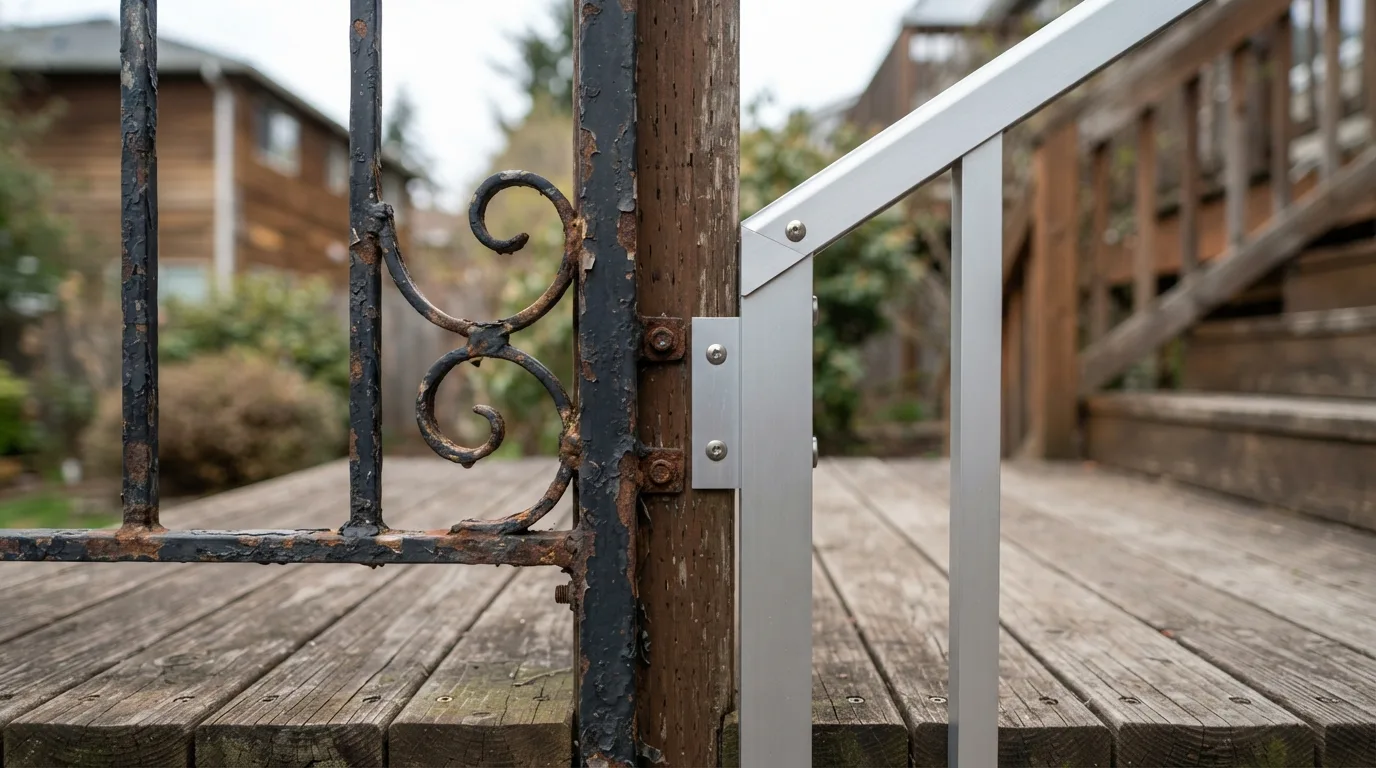
Material Properties, Structural Performance, and Real-World Durability#
Aluminum is 65% lighter than iron (density 2.7 vs 7.8 g/cm³), which reshapes every decision downstream: installation labor, structural support requirements, and which local fabricator can handle the job. Wrought iron is medium carbon steel (0.25 to 0.6% carbon composition), making it denser, stronger under load, and far more prone to rust without continuous paint protection. The choice between them is not aesthetic preference, it is a structural and service-availability decision that most residential guides miss entirely.
Density, Weight, and Structural Load-Bearing#
Wrought iron's density advantage means a railing can span longer distances without intermediate support posts, and it tolerates higher impact loads without deflection. Aluminum's lightness cuts installation time and reduces the structural demand on the deck or stair frame itself. For a residential deck railing, both materials meet code-mandated safety loads; the difference emerges in custom applications, a tall commercial stairwell, a bridge-like span, or a railing that must absorb repeated impact. Wrought iron wins on pure load capacity; aluminum wins on ease of installation and long-term frame stress.
Durability and Lifespan Under Michigan Conditions#
Wrought iron railing rust onset occurs without paint in 2 to 3 years. Once rust starts, it accelerates: freeze-thaw cycles in Michigan winters crack paint, water penetrates, and corrosion spreads beneath the surface. Wrought iron railings require repainting every 3 to 5 years as ongoing maintenance to prevent rust and corrosion. With proper care, regular inspection, timely repainting, and prompt repair of chips, wrought iron railing estimated lifespan is 50+ years to 100+ years.
Aluminum railing estimated lifespan is 50+ years. Manufacturer claims put aluminum railing lifespan without painting at 25 to 30 years, but modern anodized finishes extend that considerably. Aluminum does not rust; it oxidizes, forming a protective white powder that is cosmetic, not structural. A Michigan homeowner can ignore aluminum for years and the railing will not fail, it will simply look weathered. Wrought iron, by contrast, fails silently: rust eats through from the inside out, and a railing that looks sound can collapse under load.
Why Wrought Iron Fell Out of Favor (and When It Still Makes Sense)#
Wrought iron dominated residential railings through the mid-20th century because it was the only material available and because labor was cheap. Repainting every few years was routine maintenance, like repainting a house. Modern homeowners expect "set and forget" durability. Aluminum arrived in the 1970s and 1980s, offering exactly that: no rust, no repainting, minimal upkeep. The shift was economic, not technical. Wrought iron did not become worse; the cost of ownership (labor, paint, inspection) became visible and unacceptable to most buyers.
Wrought iron still makes sense in three cases: (1) a historic property where authenticity matters and the owner budgets for maintenance; (2) a high-load structural application where aluminum's lower strength is a liability; (3) a custom artistic installation where wrought iron's malleability and hand-forged aesthetic justify the maintenance burden. For everyone else, wrought iron is a deliberate choice to accept repainting as permanent overhead.
Fabrication, Welding Method, and Local Service Capability#
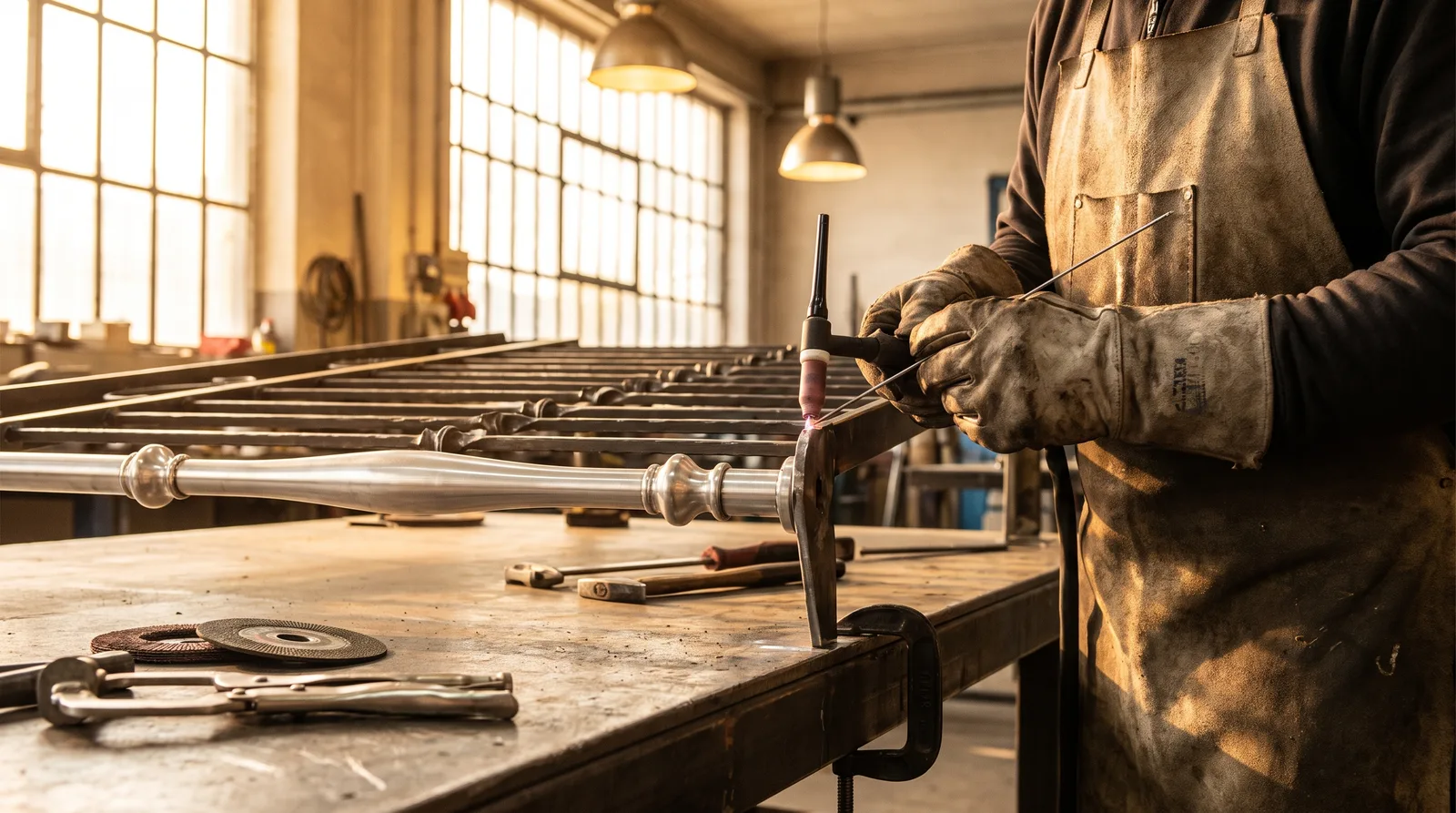
MIG welding (metal inert gas) and stick welding are the two dominant methods for railing fabrication. MIG welding material thickness range for optimal performance is 24-gauge up to 1 thick, making it ideal for aluminum and thin wrought iron stock. Stick welding excels on thicker wrought iron and structural steel. The method your local fabricator uses determines not only initial quality but emergency repair speed, and that is the hidden cost most homeowners never calculate.
MIG vs. Stick Welding: Quality Impact and Local Fabricator Differences#
MIG welding produces faster, cleaner welds on aluminum and is the standard for modern railing fabrication. Stick welding requires more skill and produces more spatter, but it is the only reliable method for thick wrought iron and field repairs on older installations. A fabricator equipped for MIG only cannot weld wrought iron; a fabricator with only stick equipment cannot efficiently build aluminum railings. A local fabricator's equipment capability (MIG vs. stick welding) determines which material can be efficiently built and repaired.
Capital M Welding and Fabrication serves Detroit, Hamtramck, Ferndale, Royal Oak, Warren, Dearborn, Southfield, and Highland Park with both MIG and stick welding capability. That dual competency matters: if you choose wrought iron and your local fabricator has only MIG equipment, you are locked into a single vendor for repairs, and if that vendor is busy or unavailable, your railing waits. If you choose aluminum and your fabricator has only stick equipment, the initial build is slow and expensive. The material choice and the fabricator's equipment must align.
Custom Fabrication and Site-Specific Changes#
A railing that fits perfectly on the drawing often does not fit on-site. Stairs slope, decks settle, and existing posts are never quite where the blueprint says they should be. Custom fabrication means the fabricator visits the site, measures the actual geometry, and builds to fit, not to spec. This requires a fabricator with the skill to adapt on the fly and the equipment to make changes without starting over.
Wrought iron is forgiving: a section that is slightly too long can be cut and re-welded; a post that is off-angle can be heated, bent, and re-welded. Aluminum is less forgiving: cutting and re-welding aluminum weakens the joint, and bending requires precision heating to avoid cracking. Wrought iron's malleability allows on-site adaptation and custom modifications, while aluminum requires precise pre-planning. For a retrofit or a site with tight tolerances, this flexibility is an asset.
Local Sourcing, Supply Chain Reliability, and Emergency Repair Availability#
Wrought iron stock is commodity steel: any steel supplier carries it, and any fabricator can order it overnight. Aluminum railing extrusions are more specialized; not every supplier stocks every profile. If your aluminum railing needs a replacement section and your fabricator's supplier is out of stock, you wait. Wrought iron stock arrives faster and from more sources.
Emergency repair availability is the inverse. A wrought iron railing that rusts or fails requires a fabricator experienced in wrought iron repair, a shrinking pool of specialists. Aluminum is easier and faster to repair because MIG-equipped fabricators are more common and standardized, making emergency service more widely available. For a commercial property or a rental where downtime costs money, aluminum's repair simplicity is a major advantage.
Cost, Maintenance, and Long-Term Repair Investment#
Installed Pricing and Long-Term Maintenance Burden#
Galvanized wrought iron railing material costs $60 to $90 per linear foot. Wrought iron deck railing typical installed cost for residential decks and porches ranges from $50 to $135 per linear foot installed, with decorative or custom systems reaching or exceeding $200/ft. For standard wrought iron installed across a typical residential span, expect material and labor costs within the mid to upper range; decorative work can approach or exceed the highest estimates.
Aluminum deck railing installed at $80 per linear foot for standard residential decks and porches, with costs ranging from $40 to $200/ft depending on product and project specifications.
The installed cost is close, but the hidden cost is maintenance. Repainting every 3 to 5 years, a cost that recurs across an ownership period, typically amounting to several hundred to over a thousand dollars per cycle depending on surface prep and local labor rates, represents a cumulative burden often exceeding the initial material difference. Aluminum requires no repainting and minimal maintenance, occasional cleaning with a hose.
Emergency Repair Availability and 24-Hour Service Access#
A wrought iron railing that rusts through or a weld that cracks requires a fabricator who knows wrought iron. In a dense urban area, that is feasible; in a rural or suburban market, it can mean a long wait or a high emergency call-out fee. Aluminum repair turnaround is faster because specialized repair procedures are simpler and more widely available.
Capital M Welding and Fabrication offers mobile and 24-hour emergency service across its service area. That availability is the difference between a railing that is fixed the same day and one that is cordoned off for a week. For a commercial property, a rental, or a safety-critical installation, 24-hour response capability is worth paying for upfront, and it is easier to guarantee with aluminum, where the repair method is standardized, than with wrought iron, where each job is custom.
Aesthetic Characteristics#
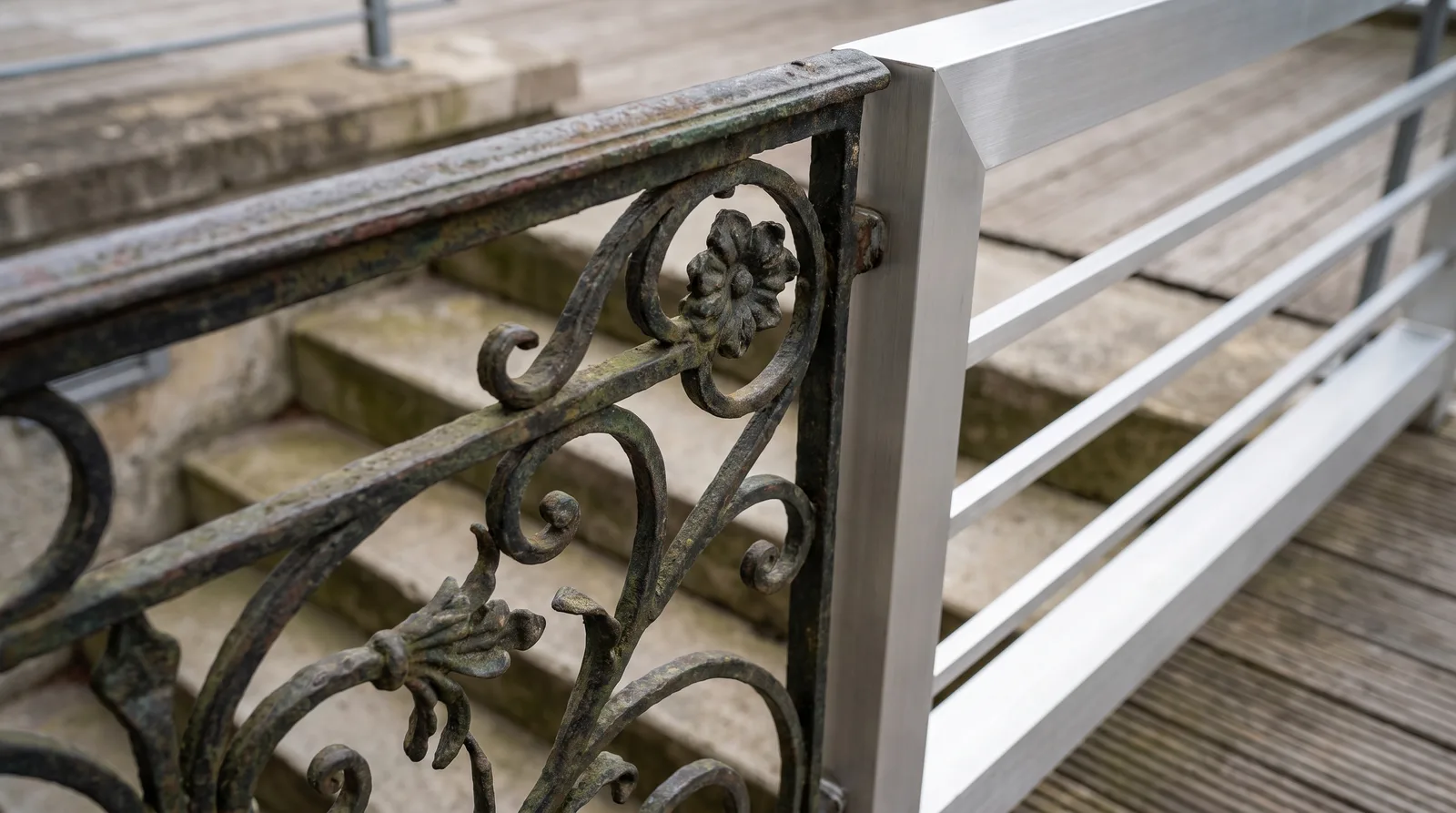
Wrought iron has a distinctive hand-forged appearance: scrolls, twists, and ornamental details that are difficult to replicate in aluminum. Wrought iron reads as traditional, high-end, and bespoke. Aluminum railings are typically sleek and modern, with clean lines and minimal ornamentation. Some aluminum profiles mimic wrought iron's curves, but the effect is different, aluminum looks manufactured, wrought iron looks crafted.
For a historic property or a design that demands ornamental detail, wrought iron is the only choice. For a contemporary home or a commercial property where clean lines and low maintenance matter, aluminum is the aesthetic fit. This is not a technical distinction; it is a design decision. But design preference should never override maintenance reality: a homeowner who loves wrought iron's look but resents repainting every few years will regret the choice.
How to Choose: Matching Your Railing to Your Structural Needs and Local Resources#
The decision hinges on three factors: structural load, maintenance tolerance, and local fabricator capability.
1. Assess your structural load requirement. Is this a residential safety barrier (a deck or stair railing), or a high-load application (a bridge, a commercial stairwell, or a railing that must absorb repeated impact)? For residential code compliance, both materials work. For heavy load or custom span, wrought iron's density is an advantage.
2. Evaluate your maintenance tolerance. Can you commit to repainting every 3 to 5 years, or do you prefer a material that requires no repainting? If you own the property long-term and budget for maintenance, wrought iron is viable. If you plan to sell in the foreseeable future or you want minimal upkeep, aluminum is the pragmatic choice.
3. Confirm your local fabricator's capability. Call Capital M Welding and Fabrication or your local fabricator and ask: Do you have MIG and stick welding equipment? Can you do emergency repairs on the material you recommend? What is your response time for a safety-critical failure? A fabricator with both capabilities and 24-hour availability can handle either material; a single-method shop locks you into one choice.
4. Calculate the total cost of ownership. Compare the installed price plus the estimated repainting cost over your ownership period. For wrought iron, add multiple repaints at several hundred dollars each over time. For aluminum, add only occasional professional cleaning. The total often favors aluminum, even if the initial material cost is higher.
5. Verify supply chain and repair availability. If you choose wrought iron, confirm that your fabricator stocks or can quickly source the material and that they have the skill for emergency repairs. If you choose aluminum, confirm that the extrusion profile is available locally and that repair is straightforward.
For most Michigan homeowners and residential applications, aluminum is the pragmatic default choice: lower total cost of ownership, no repainting, and faster emergency repair. Wrought iron is the right choice when structural load capacity is the primary concern, when historic authenticity is non-negotiable, or when you are willing to budget for ongoing maintenance. The material choice and the fabricator's capability must align, and that alignment is the decision most homeowners miss.
Next step: Measure your railing's span and note any custom angles or ornamental requirements. Call Capital M Welding and Fabrication for a site visit and a free quote on both materials. A professional assessment of your specific site will clarify whether aluminum's simplicity or wrought iron's strength is the right fit for your installation.
| Material | Stock Material Cost/ft | Typical Installed Cost/ft | Custom/Decorative Range |
|---|---|---|---|
| Wrought Iron | $60–$90 | $50–$135 | Exceeds $200 |
| Factor | Wrought Iron | Aluminum |
|---|---|---|
| Rust/Corrosion Onset | 2–3 years without paint | Does not rust; oxidizes only |
| Repainting Frequency | Every 3–5 years | No repainting required |
| Estimated Lifespan | 50+ to 100+ years with care | 50+ years |
| Unpainted Lifespan | N/A (requires paint) | 25–30 years per manufacturer |
| Criterion | Wrought Iron | Aluminum |
|---|---|---|
| Relative Weight | Denser; higher load capacity | 65% lighter (density 2.7 vs 7.8 g/cm³) |
| Structural Span | Longer spans without posts | Shorter spans; lower impact resistance |
| Installation Labor | Higher due to weight | Lower; faster install |
| Custom Field Repairs | Easily re-welded and re-shaped | Cutting/re-welding weakens joints |
| Welding Method Required | Stick welding (thick stock) | MIG welding (optimal for thin stock) |
| Use Case | Reason | Trade-Off |
|---|---|---|
| Historic property | Authenticity required | Ongoing repainting and maintenance cost |
| High-load structural | Aluminum strength insufficient | Repainting every 3–5 years mandatory |
| Custom artistic install | Hand-forged aesthetic | Maintenance burden justified by design value |
Wrought Iron vs. Aluminum Lifetime Cost of Ownership Calculator
Compares initial fabrication/installation costs and long-term maintenance expenses (wire-brushing, priming, and repainting every 5 years for wrought iron versus virtually zero maintenance for powder-coated aluminum) over a chosen lifespan.
Wrought Iron Initial Cost:
Aluminum Initial Cost:
Wrought Iron Maintenance (Repainting):
Aluminum Maintenance:
Wrought Iron Total Cost of Ownership:
Aluminum Total Cost of Ownership:
Lifetime Premium for Wrought Iron:
Frequently Asked Questions
Why is wrought iron no longer popular for residential railings?
Wrought iron fell out of favor because modern homeowners expect minimal maintenance and long-term durability without repainting. The shift was economic: maintenance labor for regular repainting every 3 to 5 years became unacceptable compared to aluminum's "set and forget" durability, even though wrought iron's structural performance did not decline. Aluminum, introduced in the 1970s-1980s, offered rust-free, paint-free ownership.
What are the main disadvantages of aluminum railings?
Aluminum has lower load-bearing strength than wrought iron, limiting its use in high-impact or long-span applications. It cannot be easily re-welded or re-shaped on-site; cutting and re-welding weakens the joint, and bending requires precision heating to avoid cracking. Field customization is difficult, making aluminum less suitable for retrofit projects or sites with irregular geometry.
How much does 100 feet of wrought iron railing cost installed?
Typical installed wrought iron railing costs $50 to $135 per linear foot, placing a longer run at a corresponding multiple of that rate. Decorative or custom systems can reach or exceed $200 per foot, pushing longer installations into substantially higher territory. Stock material alone (galvanized wrought iron) runs $60 to $90 per foot, with fabrication and labor adding the remaining cost.
Is wrought iron more expensive than aluminum for railings?
Installation costs are comparable: wrought iron ranges $50 to $135/ft installed while aluminum spans $40 to $200/ft depending on product quality and complexity. However, wrought iron carries hidden ongoing costs, repainting every 3 to 5 years, that accumulate to significantly higher total cost of ownership over decades. Aluminum's initial price advantage expands dramatically when maintenance is factored in.
How should I choose between wrought iron and aluminum for an outdoor railing?
Choose aluminum if you want durability without maintenance or if the railing spans standard residential distances. Choose wrought iron only if you have a specific reason: historic authenticity, a high-load structural application aluminum cannot handle, or a custom artistic design worth the repainting commitment. For most residential decks and porches, aluminum eliminates decades of maintenance labor.
Can a fabricator with only MIG welding equipment handle wrought iron railings?
Not for thick wrought iron. MIG welding performs best on material from 24-gauge up to 1 inch thick, which suits aluminum and thin wrought iron stock, but stick welding is the only reliable method for thick wrought iron and for field repairs on older installations. If you choose wrought iron and your fabricator has only MIG equipment, you are locked into a single vendor for repairs, so confirm they have both.
Why does the choice of material matter to local fabricator availability?
Different materials require different welding equipment: MIG for aluminum, stick for thick wrought iron. A fabricator equipped with only one method cannot efficiently build the other material, and emergency repairs become impossible if your chosen material does not match the fabricator's capability. Dual-equipped shops (like those in Detroit and Royal Oak) eliminate vendor lock-in risk regardless of your material choice.
What is the best material for an outdoor railing?
Choose aluminum for most residential outdoor railings, it resists rust, requires no repainting, and lasts decades with minimal maintenance. If you need maximum load capacity or want an authentic historic look, wrought iron is superior but demands regular repainting to prevent rust. Your choice depends on whether you prioritize low maintenance or structural strength and traditional aesthetics.
Sources
- www.homeadvisor.com (via Perplexity sonar-pro) - Homeadvisor (2026-06-20)
- www.angi.com (via Perplexity sonar-pro) - Angi (2026-09-06)
- www.angi.com (via Perplexity sonar-pro) - Angi (2026-09-06)
- MIG vs. TIG Welding: Why You Should Check What Your Fabricator Uses - Impact Fab Inc - Impactfab (2026-09-09)
- Fabrication and Welding: Key Differences and Best Practices - Doug Machine (2026-09-09)
- The Durability of Iron vs. Other Metals in Construction: A Comparative Analysis of Structural Longevity - Palmcityironworks (2026-09-09)