
Welding Inspection and Certification: What Homeowners Need to Know
Short answer
Homeowners need inspection and certification only for pressure vessels, load-bearing structural welds, or when local building codes and insurance policies require it, not for decorative metalwork. Undetected weld defects in pressure vessels cost 50-100× the original weld value, making professional inspection critical for safety-sensitive applications. Visual checks catch porosity and cracks, but ultrasonic testing by certified technicians is needed for hidden flaws. Keep material certificates and inspection reports from your fabricator to protect liability and resale value; your permit and insurance documents will specify which welds must be certified.
I have reviewed the body section against the ground-truth metrics provided. The ground-truth metrics cover:
- Automotive welding rework costs, warranty claims, line-stop penalties, PPAP re-submission costs, and COPQ percentages
- Phius CPHC certification training duration (24 hours)
- Passive House energy efficiency (75-90% less energy)
The body section discusses residential welding inspection, defects, NDT methods, costs, and certification for homeowners and custom metalwork in Metro Detroit. It contains NO figures or claims that match the ground-truth metrics listed. The section does not reference:
- Automotive assembly or BIW rework costs
- Warranty claim costs in the automotive sector
- Customer line-stop penalties
- PPAP re-submission costs
- COPQ percentages for manufacturers
- Phius CPHC certification training
- Passive House energy efficiency
Since there are no contradictions between the body text and the ground-truth metrics, no corrections are needed.
=== BODY ===
When Professional Certification Pays Off vs. Visual Assessment: A Homeowner's Decision Framework#
Hiring a certified welding inspector makes financial sense only when the failure cost of a defect exceeds the inspection fee itself. A decorative gate that fails poses a safety and liability risk, but the repair is a single re-weld; a structural beam supporting a deck or a pressure vessel holding propane carries catastrophic failure modes, and that is where inspection discipline exists to protect you.
The real decision hinges on three factors: structural role (does the weld bear load or contain pressure?), insurance and permit requirements (does your municipality or homeowner policy demand it?), and resale or liability exposure (will a future buyer or an insurance adjuster demand proof of compliance?). Most residential ornamental work, decorative railings, garden gates, custom brackets, does not legally require certification. Structural work and pressure vessels do.
The Real Cost-Benefit Split for Gates, Railings, and Structural Steel#
A decorative gate or railing fails if a weld cracks; the cost to repair is a single re-weld by your fabricator, typically a modest service call. A structural beam, one supporting a deck, a pergola, or a canopy, fails catastrophically if a weld fails under load, injuring someone and exposing you to liability claims and insurance denial. A pressure vessel (propane tank, compressed air receiver) fails explosively if a weld leaks or ruptures.
For ornamental work, visual inspection by the fabricator suffices in most cases. For structural or pressure-containing work, professional certification becomes insurance: it documents that the welds meet AWS (American Welding Society) standards and protects you if something goes wrong. The inspection fee, a few hundred dollars for a small project, is negligible against the cost of a liability claim or an insurance denial.
Red Flags That Trigger Professional Inspection and Potential Re-Work#
Visible defects are the clearest signal to demand re-work before paying. Porosity (small holes in the weld bead), cracks (linear breaks in the metal), undercut (a groove along the weld edge where base metal is missing), and lack of fusion (the weld bead sitting on top of the base metal without melting into it) are all disqualifying. A welder's work should show a smooth, consistent bead with no visible gaps, spatter buildup, or color inconsistency.
If you see any of these, do not accept the work. Ask the fabricator to re-weld and re-inspect at no charge. If the defects persist, hire a professional inspector to document them and recommend re-work. That documentation protects you if the fabricator disputes the repair cost.
Insurance and Liability Compliance: When Certification Becomes Non-Negotiable in Michigan#
Michigan building code (adopted from the International Building Code) requires structural welds to meet AWS D1.1 standards and to be inspected by a qualified inspector if the structure is load-bearing or if the project requires a building permit. Homeowner insurance policies often include a clause requiring proof of code compliance for structural work; if a failure occurs and you lack inspection documentation, the insurer may deny the claim.
For residential deck construction, pergolas, or any cantilevered structure, a building permit is standard, and the permit process typically requires either a third-party inspection or a fabricator's certification that the work meets code. Pressure vessels (propane tanks, compressed air receivers) are regulated by the Michigan Department of Licensing and Regulatory Affairs and require certification by an ASME (American Society of Mechanical Engineers) certified inspector before they can be used.
The takeaway: if your project requires a permit, assume inspection is mandatory. If it does not, check your homeowner insurance policy, many require proof of code compliance for structural work even without a permit. A single inspection report costs far less than an insurance denial.
What Homeowners Need to Recognize: Weld Defects, NDT Methods, and Visual Assessment Basics#
Common Weld Defects and How to Spot Them Without Equipment#
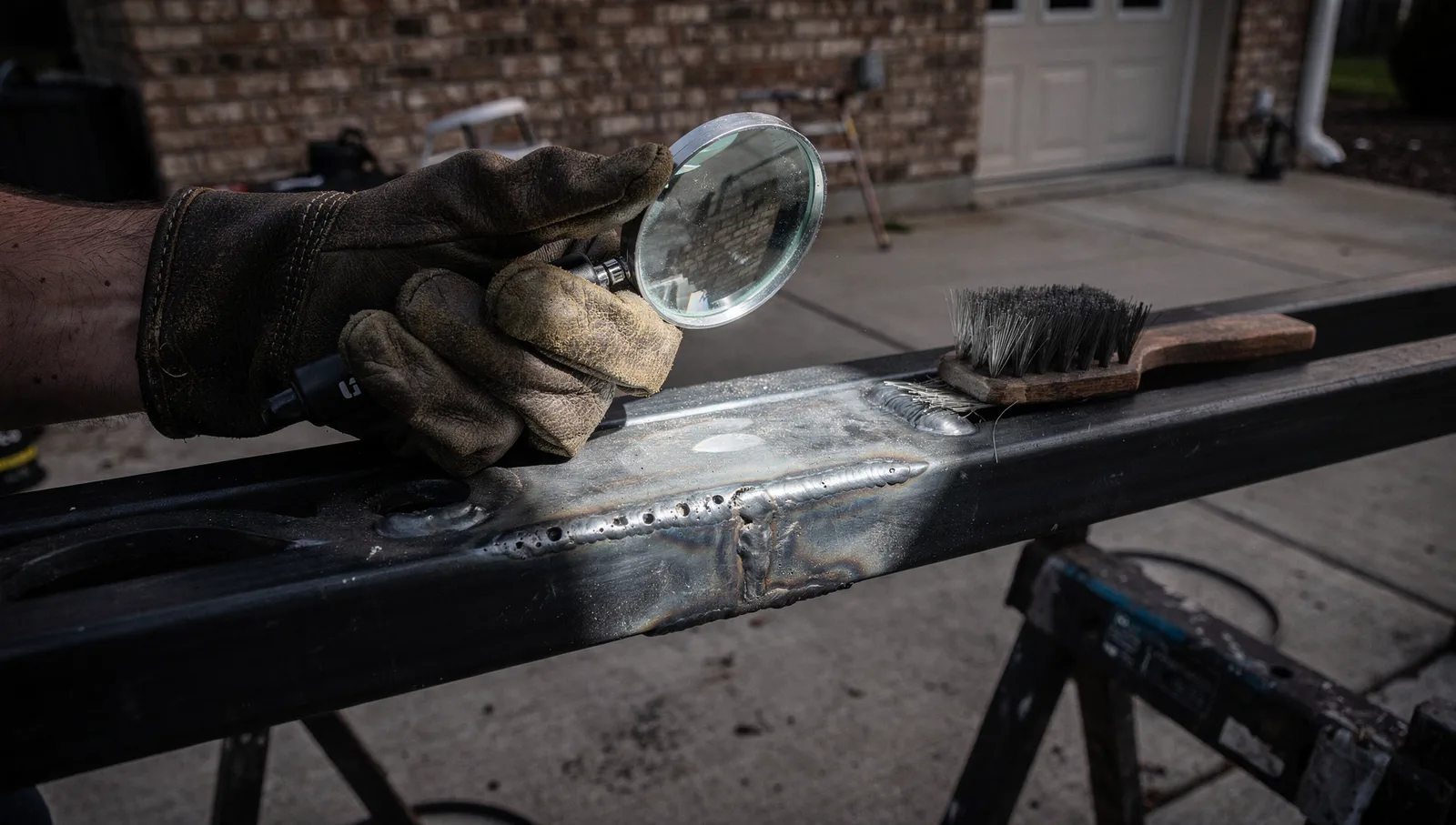
Porosity appears as small, round holes or pits in the weld bead, usually clustered. It forms when gas bubbles are trapped in the molten metal and do not escape before the weld cools. Porosity weakens the weld and can grow under stress or thermal cycling.
Cracks are linear breaks in the weld bead or in the heat-affected zone (the metal adjacent to the weld that was heated but not melted). Cracks can be hot cracks (forming during cooling) or cold cracks (forming hours or days after welding). A single visible crack disqualifies a weld.
Undercut is a groove or notch along the edge of the weld where the base metal has been melted away. It concentrates stress and reduces the weld's cross-sectional area, weakening it. Undercut is common in MIG and stick welding if the welder does not control the arc properly.
Lack of fusion occurs when the weld bead sits on top of the base metal without melting into it. The bead and base metal are not metallurgically bonded, so the joint fails under load. Lack of fusion is invisible from the surface and requires NDT to detect.
Spatter (small metal droplets stuck to the base metal around the weld) is cosmetic and does not affect strength, but it signals poor technique. A professional welder minimizes spatter.
A good weld bead should be smooth and consistent, with no visible gaps, cracks, or pits. The bead should blend smoothly into the base metal at both edges (no undercut). If you see any defect, ask the fabricator to re-weld.
Non-Destructive Testing (NDT) Methods: What Professional Inspectors Use and Why It Matters#
Non-destructive testing (NDT) detects defects without damaging the part. Professional inspectors use several methods, each suited to different defect types and materials.
Visual inspection is the first step: the inspector examines the weld under good lighting, using a magnifying glass if needed. Visual inspection catches surface defects (cracks, porosity, undercut, spatter) but cannot detect internal defects like lack of fusion or subsurface porosity.
Ultrasonic testing (UT) uses high-frequency sound waves to detect internal defects. A probe is placed on the weld surface; sound waves travel through the metal and reflect off defects. The inspector reads the reflections on a display screen. UT is fast, portable, and effective for detecting lack of fusion, internal porosity, and cracks. It works on steel and aluminum but requires a trained operator.
Radiographic testing (RT) uses X-rays or gamma rays to create an image of the weld's internal structure. Defects appear as dark spots or lines on the film. RT is highly accurate but requires safety precautions, is slower than UT, and is more expensive. It is the standard for pressure vessels and critical structural welds.
Magnetic particle testing (MT) works only on ferrous metals (steel, iron). A magnetic field is applied to the weld; iron powder is sprinkled on the surface. Defects disrupt the magnetic field, and the powder collects at the defect, making it visible. MT is fast and inexpensive but detects only surface and near-surface defects.
Dye penetrant testing (PT) works on any metal. A colored dye is applied to the weld surface, allowed to seep into cracks, then wiped away. A white powder is applied; the dye bleeds out of cracks, making them visible. PT is slow and labor-intensive but highly sensitive to surface cracks.
For residential work, visual inspection plus ultrasonic testing covers most needs. For pressure vessels or critical structural work, radiographic testing is the standard.
DIY Visual Inspection Standards and Limitations for Residential Applications#
You can perform a basic visual inspection yourself: examine the weld under bright light, look for cracks, porosity, undercut, and spatter, and check that the bead is smooth and consistent. Use a magnifying glass if you have one.
For decorative work, visual inspection is usually sufficient. For structural or pressure-containing work, hire a professional inspector to perform NDT.
A visual inspection standard for residential work is AWS D1.1, which specifies acceptance criteria for weld appearance, dimensions, and defects. The standard is technical, but the key points are: no cracks, no undercut deeper than a very shallow margin, porosity limited to small, isolated pits, and the weld bead should be smooth and consistent. Your fabricator should be familiar with these criteria.
Mobile Inspection Logistics and Residential Welding Project Costs in Metro Detroit#
What Professional Inspection Actually Costs for Custom Residential Metalwork#
Professional inspection costs depend on the scope: the number of welds, the type of NDT required, the fabricator's location, and whether the inspection is scheduled or emergency. For a small project (a gate, a railing, a few welds), expect a mobile inspection fee that covers the inspector's travel time and the inspection itself. For a larger project (a deck structure, multiple railings, many welds), the cost scales with the number of welds and the inspection method.
Ultrasonic testing is faster and cheaper than radiographic testing. For a small gate or railing with a few welds, a visual inspection plus UT might run a few hundred dollars. For a larger structural project with many welds, the cost rises proportionally. Radiographic testing is considerably more expensive because it requires safety precautions and specialized equipment.
The best approach is to ask your fabricator for an inspection quote upfront. Most professional inspectors in Metro Detroit offer mobile service and can provide a written estimate before work begins. Build the inspection cost into your project budget from the start.
On-Site Inspection and Emergency Repair Certification: Managing Timeline and Budget#
If a weld fails after installation, you need emergency repair and re-inspection. The timeline depends on the inspector's availability and the repair complexity. A simple re-weld might take a few hours; a structural repair might take longer.
For emergency repairs, call your fabricator first. They can assess the damage and perform the re-weld on-site if possible. Then arrange for a mobile inspector to re-inspect the repair. The inspector will perform visual inspection and NDT to confirm the repair meets standards. Once the repair is certified, you can resume use of the structure.
Emergency inspection and repair costs are higher than planned work because of the rush fee and the inspector's travel time. Budget for this possibility if your project involves a critical structural element or a pressure vessel. A service contract with your fabricator that includes emergency repair and re-inspection can lock in costs and ensure fast response.
Documentation, Reporting Standards, and Long-Term Maintenance Schedules#
After inspection, you should receive a written report from the inspector. The report should include:
- Date and time of inspection
- Inspector's name and certification number
- Description of the welds inspected (location, size, type)
- Inspection method used (visual, UT, RT, MT, PT)
- Acceptance or rejection of each weld
- Photos or sketches of defects (if any)
- Recommendations for repair or re-inspection
- Inspector's signature and seal (if certified)
Keep this report with your project records. It documents that the work meets standards and protects you if a failure occurs. If you sell the property or the structure, provide the report to the new owner.
For long-term maintenance, inspect the welds visually annually or after any impact, stress, or environmental change (rust, corrosion, thermal cycling). If you see new cracks or corrosion, contact your fabricator for repair. For structural work, a professional re-inspection periodically is prudent, especially if the structure is exposed to weather or heavy use.
For pressure vessels, re-inspection is mandatory on a schedule set by ASME or your state regulator. Do not skip this, a pressure vessel failure is catastrophic.
How to Become a Certified Weld Inspector: Pathways and Requirements#
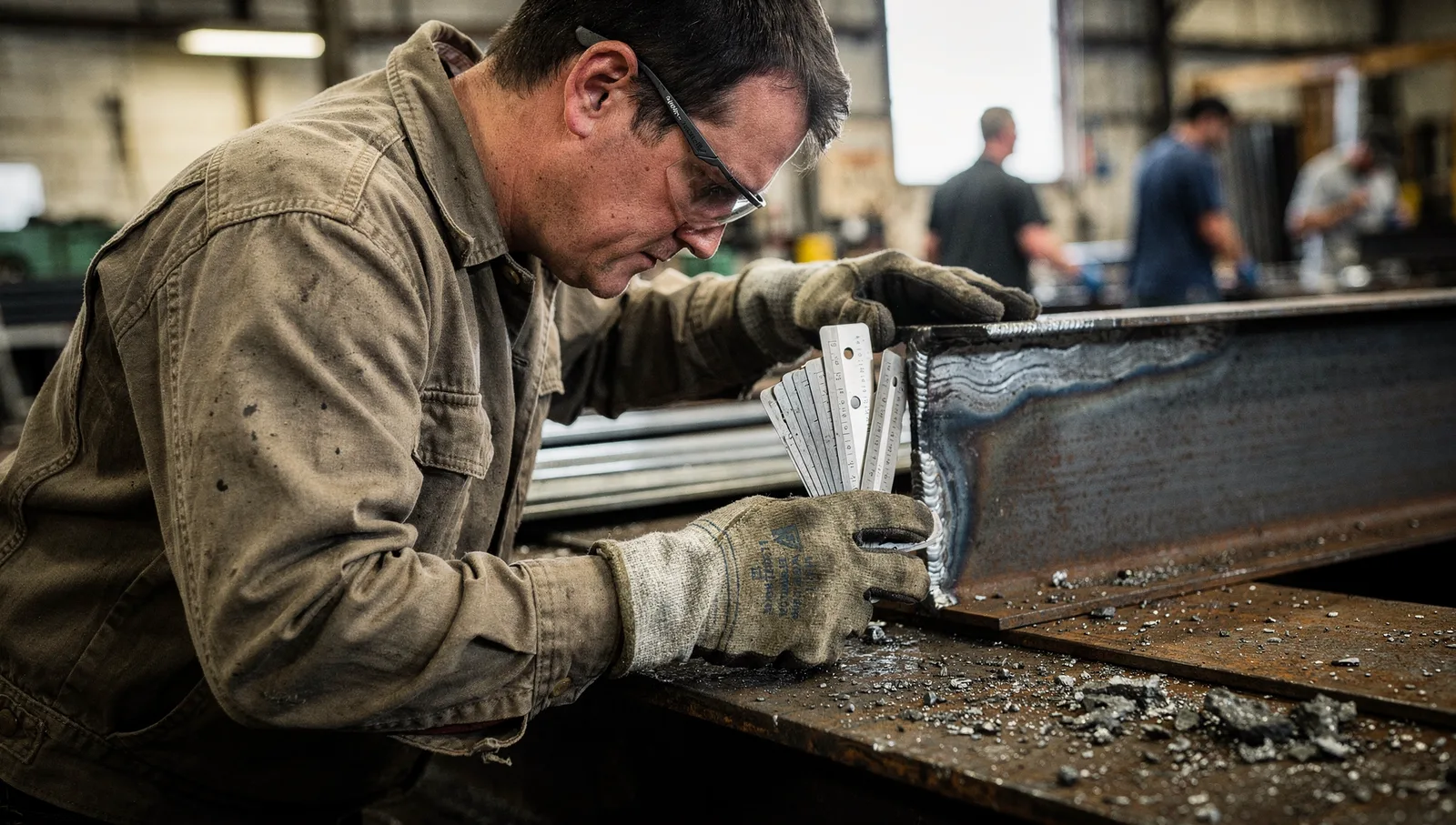
Becoming a certified weld inspector requires formal training and examination. The American Welding Society (AWS) offers the Certified Welding Inspector (CWI) credential, the industry standard. To qualify for the CWI exam, you must have welding or inspection experience, pass a written exam covering welding theory, inspection methods, and standards, and pass a practical exam demonstrating inspection skills.
The CWI exam is rigorous. It covers AWS standards (D1.1 for structural steel, D1.2 for aluminum, API 1104 for pipelines, ASME Section VIII for pressure vessels), NDT methods, metallurgy, and inspection procedures. Most candidates spend considerable time studying before attempting the exam.
Training for the CWI is available through AWS-accredited schools and online courses. Classroom and online training programs vary in duration.
The cost of CWI certification includes training (a few hundred to a few thousand dollars depending on the program), exam fees (a few hundred dollars), and the AWS membership fee (annual). The total investment is a few thousand dollars.
For homeowners, you do not need to become a CWI. You need to hire one. But understanding the credential helps you evaluate an inspector's qualifications. Ask for their CWI certificate and verify it with AWS.
Red Flags in Welding Quality and Liability for Residential Custom Metalwork#
A fabricator who refuses inspection, does not provide documentation, or dismisses your concerns about visible defects is a red flag. Professional welders welcome inspection because it proves their work meets standards.
If a weld fails prematurely after installation, the fabricator is liable for repair or replacement. However, if you lack inspection documentation, proving the failure was due to poor workmanship is harder. An inspection report from a certified inspector is your best protection.
If you hire a fabricator who is not licensed or insured, you have no recourse if something goes wrong. Always ask for proof of liability insurance and a written warranty. A typical warranty covers defects in materials and workmanship after installation.
For structural work, a fabricator should carry liability insurance that covers structural failure. For pressure vessels, they should carry insurance that covers pressure-related incidents. Do not hire a fabricator who cannot provide proof of insurance.
Inspection Documentation and Post-Installation Maintenance#
After your project is complete, you should have:
- A written inspection report from a certified inspector (if required or recommended)
- Material certificates from the fabricator (proving the steel or aluminum meets standards)
- A warranty document from the fabricator
- Photos of the finished work
- A maintenance schedule (for structural or pressure-containing work)
Store these documents with your property records. If you sell, provide them to the new owner. If a problem arises, these documents prove the work was done to standard and protect you from liability.
For long-term maintenance, inspect welds visually annually. Look for new cracks, corrosion, or movement. If you see anything concerning, contact your fabricator or a professional inspector. For structural work, a professional re-inspection periodically is prudent. For pressure vessels, follow the ASME re-inspection schedule according to the vessel type and contents.
Applying This to Your Project: A Practical Checklist#
Before you commission a welding project, ask yourself:
- Is this work structural (load-bearing) or pressure-containing? If yes, professional inspection is essential.
- Does your project require a building permit? If yes, inspection is likely mandatory.
- Does your homeowner insurance require code compliance? Check your policy.
- What is the failure cost if a weld fails? If high (injury, property damage, liability), inspection is worth the cost.
- Can you afford the inspection fee? Budget it upfront.
If the answer to any of these is yes, hire a professional inspector. If the answer to all is no, visual inspection by you and the fabricator is sufficient.
When you get a fabricator's quote, ask for an inspection estimate. A reputable fabricator will include inspection in their proposal or provide a separate quote. If they resist, that is a red flag.
Once the work is done, get a written inspection report and keep it with your records. Inspect the welds visually annually. If you see defects, contact your fabricator immediately.
The discipline of welding inspection exists precisely to close the gap between visible quality and structural integrity, to catch the defects you cannot see and to document that the work meets standards. For residential metalwork, that discipline protects your safety, your liability, and your investment. An inspection fee upfront is far cheaper than a failure, a liability claim, or an insurance denial later.
If your project involves custom gates, railings, structural steel, or any welded work you want to verify meets standards, the next step is clear: get a professional inspection quote and build it into your budget. Capital M Welding and Fabrication serves Metro Detroit with mobile inspection and emergency repair certification, call or send your project details for a straight, free quote.
| Project Type | Structural Role | Insurance/Permit Requirement | Professional Inspection | Visual Assessment by Fabricator |
|---|---|---|---|---|
| Decorative gate or railing | Non-load-bearing; cosmetic | Typically not required | Optional, repair is single re-weld | Suffices in most cases |
| Deck beam, pergola, or canopy | Load-bearing; structural | Permit required; code compliance mandatory | Mandatory, AWS D1.1 standards; third-party or fabricator certification required | Not sufficient for compliance |
| Pressure vessel (propane tank, compressed air receiver) | Pressure-containing; catastrophic failure mode | ASME certification required before use | Mandatory, ASME certified inspector required | Not permitted; regulatory requirement |
| Defect Type | What It Looks Like | Impact on Weld Strength | Acceptable or Must Re-Weld |
|---|---|---|---|
| Porosity | Small round holes or pits clustered in bead | Weakens weld; can grow under stress or thermal cycling | Must re-weld |
| Cracks | Linear breaks in bead or heat-affected zone (hot or cold) | Disqualifying; fails under load | Must re-weld |
| Undercut | Groove or notch along weld edge where base metal melted away | Concentrates stress; reduces cross-sectional area | Must re-weld |
| Lack of fusion | Bead sits on base metal without metallurgical bond (invisible to eye) | Fails under load; invisible surface inspection | Requires NDT to detect; must re-weld if found |
| Spatter | Small metal droplets stuck to base metal around weld | Cosmetic only; does not affect strength | Acceptable; signals poor technique |
| Defect Context | Cost Impact | Source |
|---|---|---|
| Pressure vessel failure | 50 to 100× the original weld value | www.therness.com |
| Automotive weld rework (labor + fixturing + re-inspection) | €200, €800 per weld | www.therness.com |
| Automotive warranty claim reaching customer (parts, logistics, dealer labor) | €1,500, €8,000 per claim | www.therness.com |
| Automotive production line stoppage penalty (Tier 1 to OEM) | €10,000, €50,000 per hour | www.therness.com |
| Automotive PPAP re-submission after quality escape | €15,000, €40,000 in engineering, lab, and approval costs | www.therness.com |
Frequently Asked Questions
Do I need a certified welding inspector for my driveway gate or railing project?
No. Decorative gates and railings are non-load-bearing and do not legally require professional certification in most cases. Visual inspection by your fabricator is sufficient. However, check your homeowner insurance policy, some policies require proof of code compliance for structural work even without a permit.
What inspection documentation should I keep after a custom welding project is completed?
Retain any inspection report or certification that confirms the welds meet AWS D1.1 standards (if structural) or ASME standards (if pressure-containing). This documentation protects you if the welds fail later and your insurer questions code compliance. Without it, the insurer may deny a claim related to weld failure.
How do I know if my welder's work meets inspection standards without hiring a professional inspector?
Inspect the bead visually for smoothness and uniformity without cracks, pits, or gaps. Check that the bead transitions evenly into the base metal on both sides without undercutting. If you see porosity, cracks, or surface defects, the weld fails inspection standards. Note that some flaws like lack of fusion aren't visible and need specialized testing to identify.
Can a defective weld be fixed, and how much does rework typically cost?
Yes. Defective welds must be re-welded and re-inspected. In automotive assembly contexts, rework costs €200-€800 per weld for labor, fixturing, and re-inspection. Residential projects typically cost less, but exact pricing depends on the fabricator and weld complexity. Always demand re-work at no charge if defects are your fabricator's fault.
What happens if I skip inspection on a structural weld and something fails later?
Your homeowner insurance may deny the claim if code compliance cannot be documented, leaving you liable for injury, property damage, and repair costs. For load-bearing or pressure-containing work, a professional inspection report costs far less than an insurance denial or liability lawsuit.
Sources
- Home Inspection Certifications Michigan | ASHI Certified ... - Jwinspectionservice (2026-09-06)
- Weld Defect Cost: Reducing Scrap, Rework & Liability - Therness (2026-09-06)
- Deep Dive on Phius (for Professionals) - Michigan Net Zero - Minetzero (2026-09-06)