
Decking Handrails and Structural Welding: Safety Standards and Design
Short answer
Decking handrails and structural welding require compliance with AWS D1.1/D1.1M for carbon and low-alloy steels, AWS D1.3/D1.3M:2018 for sheet steel up to 80 ksi yield, and AWS D1.8/D1.8M:2025 for seismic applications. Welding through decking triggers procedure qualification testing, as do vertical or overhead positions and non-standard steels. Fabricators must manage confined space hazards-fumes, electrical shock, moisture, temperature-and ensure worker extraction capability when welders work inside structural boxes.
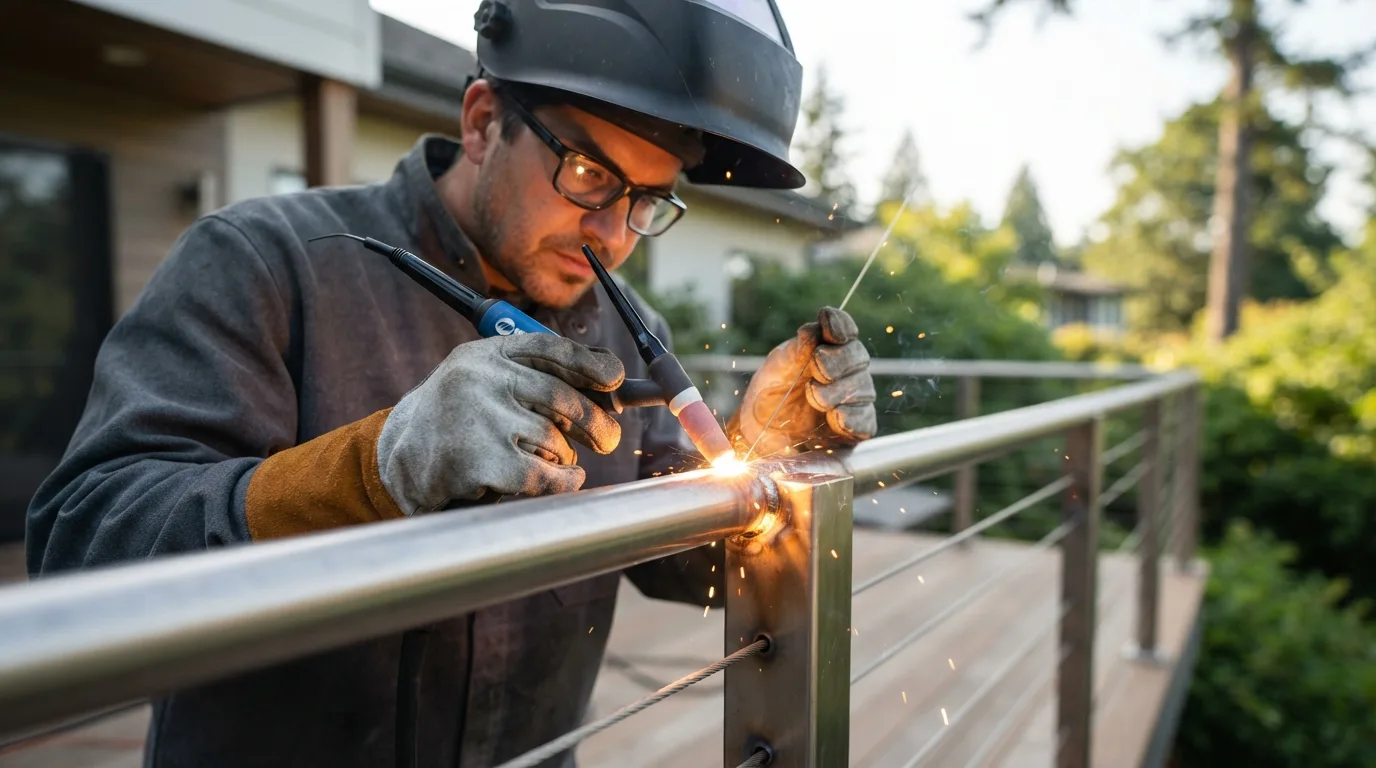
“The exceptions include welding to non-planar surfaces, welding in the vertical or overhead positions, welding through decking, or welding to steels other than those listed in the Bridge Welding Code.”
— FHWA, Federal Highway Administration
Governing Standards for Structural Welding in Decking and Handrail Systems#
Decking handrails and structural connections in decking systems must comply with specific AWS (American Welding Society) structural welding codes that establish requirements for material, procedure, fabrication, and inspection.
AWS D1.1/D1.1M: The Primary Code for Structural Steel#
AWS D1.1/D1.1M is the governing code for welding structural steel in any type of welded structure made from commonly used carbon and low-alloy steels (Webstore). This standard covers design, procedure qualification, fabrication, and inspection requirements for structural connections, including those in decking handrail systems where carbon or low-alloy steel is the primary material.
AWS D1.3/D1.3M:2018: Sheet Steel Applications#
AWS D1.3/D1.3M:2018 covers the requirements for welding sheet steel having a minimum specified yield point no greater than 80 ksi (550 MPa) (Webstore). The code applies to any welded joint made from commonly used structural quality low-carbon hot rolled and cold rolled sheet and strip steel, with or without zinc coating (galvanized). Decking systems that incorporate sheet steel components or thin-wall structural members fall under this standard's design, prequalification, qualification, fabrication, and inspection provisions.
AWS D1.8/D1.8M:2025: Seismic Force Resisting Systems#
AWS D1.8/D1.8M:2025 supplements the requirements of AWS D1.1/D1.1M and applies to welded joints in Seismic Force Resisting Systems designed in conformance with AISC 341 (Webstore). Where decking handrails or structural members are part of a seismic force resisting system, this supplement establishes additional requirements for joint design and qualification.
Welding Procedure Qualification for Decking Applications#
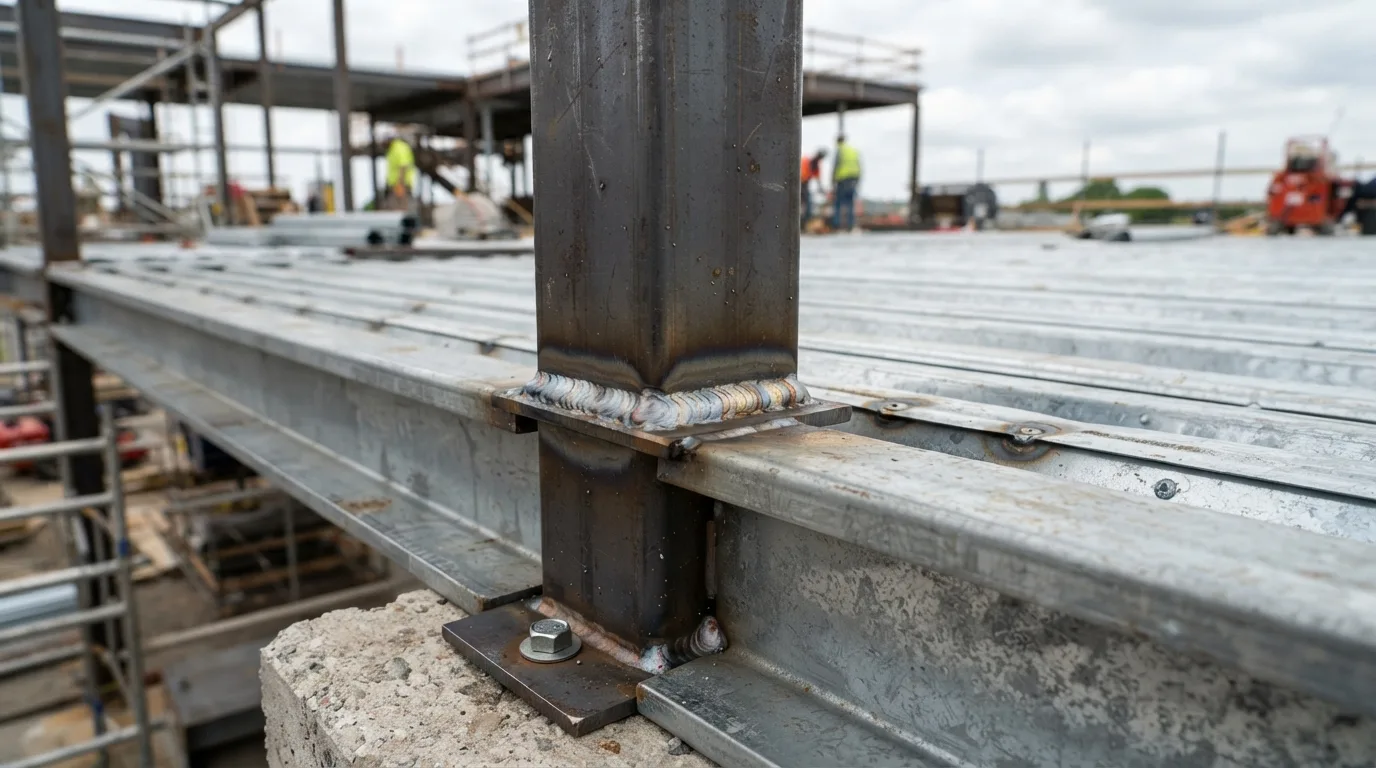
Welding procedure qualification testing is required for certain decking applications and must be completed before production welding begins, including welding through decking, welding to non-planar surfaces, welding in vertical or overhead positions, and welding to steels other than those listed in the Bridge Welding Code (Fhwa).
Conditions Requiring Procedure Qualification Testing#
Stud welding procedures do not require qualification testing when proper procedures are used, except when welding to non-planar surfaces, welding in the vertical or overhead positions, welding through decking, or welding to steels other than those listed in the Bridge Welding Code (Fhwa). When conditions such as welding through decking, welding to non-planar surfaces, welding in vertical or overhead positions, or welding to steels other than those in the Bridge Welding Code apply - as covered above - the fabricator must conduct procedure qualification tests before production welding begins.
Confined Space Safety and Accessibility in Structural Box Fabrication#
Structural box members used in decking systems sometimes require welders to work inside the box itself. This creates confined space hazards that fabricators must identify and control.
Hazard Management in Confined Spaces#
Fabricators must manage environmental conditions, welding fumes, equipment installation, temperature, electrical (voltage) limits, moisture (including perspiration), and electrical shock in confined spaces where welders work inside structural boxes (Fhwa). Ventilation or fume extraction systems must be sized and positioned to control welding fumes at the source; electrical equipment must be grounded and isolated from moisture exposure to prevent shock hazards; temperature monitoring prevents heat stress; and moisture barriers or active drying reduce condensation that can degrade weld quality or create electrical hazards.
Beyond hazard control, the fabricator must be able to extract workers from confined spaces in the event of injury or health emergency (Fhwa). This means establishing rescue procedures, training personnel, and ensuring that rescue equipment and access routes are in place before welding begins.
Accessibility Constraints in Box Design#
Welders must have physical access to bring equipment into the confined space, reach the connection to be welded, and see the weld puddle during welding (Fhwa). Fabricators should review box geometry early in the design phase to identify potential access issues and coordinate with the engineer on solutions.
If your decking handrail or structural box project requires welding procedure qualification or confined space safety planning, contact Capital M Welding and Fabrication for a free assessment.
| Code | Base Material | Yield Point / Grade | Primary Clauses |
|---|---|---|---|
| AWS D1.1/D1.1M | Carbon and low-alloy steels | Not specified | General provisions, design, qualification, fabrication, inspection |
| AWS D1.3/D1.3M:2018 | Hot rolled and cold rolled sheet steel (with or without zinc coating) | ≤80 ksi (550 MPa) | General provisions, design, prequalification, qualification, fabrication, inspection |
| AWS D1.8/D1.8M:2025 | Carbon and low-alloy steels in Seismic Force Resisting Systems | Per AWS D1.1/D1.1M | Supplement to D1.1/D1.1M; applicable to AISC 341 compliance |
| AWS D1.2/D1.2M | Structural aluminum | Not specified | WPS qualification, welder qualification, prequalified joints, fabrication, inspection, NDT |
| Application Condition | Qualification Testing Requirement | Applicable Standard |
|---|---|---|
| Welding to planar surfaces in flat position | Not required when proper procedures used | Bridge Welding Code |
| Welding to non-planar surfaces | Required | Bridge Welding Code |
| Welding in vertical or overhead positions | Required | Bridge Welding Code |
| Welding through decking | Required | Bridge Welding Code |
| Welding to steels other than those listed in Bridge Welding Code | Required | Bridge Welding Code |
| Hazard Category | Specific Considerations | Regulatory Source |
|---|---|---|
| Environmental conditions | Ventilation, air quality | OSHA 19 CFR 1910 Subpart Q |
| Welding fumes | Fume extraction, source control | OSHA 19 CFR 1910 Subpart Q |
| Equipment installation | Safe placement, cable routing | OSHA 19 CFR 1910 Subpart Q |
| Temperature | Monitoring and control | OSHA 19 CFR 1910 Subpart Q |
| Electrical (voltage) limits | Grounding, insulation, voltage control | OSHA 19 CFR 1910 Subpart Q |
| Moisture and perspiration | Drying, insulation, moisture barriers | OSHA 19 CFR 1910 Subpart Q |
| Electrical shock | Protective grounding, PPE | OSHA 19 CFR 1910 Subpart Q |
| Worker rescue | Rescue procedures, equipment, training in place before work begins | OSHA 19 CFR 1910 Subpart Q |
Frequently Asked Questions
When does welding of decking components require procedure qualification testing instead of relying on prequalified procedures?
Stud welding procedures need qualification testing when welding through decking, welding to curved or uneven surfaces, welding in vertical or overhead positions, or welding to steel grades not covered by standard prequalified procedures. Standard prequalified procedures work fine for typical applications, but these special conditions require testing before production work can start.
What accessibility requirements must fabricators meet when designing and building structural boxes with internal welding?
Fabricators must ensure welders can transport equipment inside the box, access the weld joint, and view the weld puddle during work. Design considerations should address potential accessibility challenges early, particularly for boxes with constrained internal spaces, intricate reinforcement patterns, or restricted entry points, which may necessitate design adjustments or modified fabrication procedures.
Sources
- Bridge Welding Reference Manual - Federal Highway Administration - Fhwa (2026-09-13)
- Welding Structural Codes - Webstore (2026-09-15)
- American Welding Society (AWS) - American Welding Society (AWS) (2025)
- Welding of Aluminium Connections - Engineering Express - Engineeringexpress (2026-03-04)